

Donor Retention & Non-Profit CRM Deliverability: Blackbaud, HubSpot & Dedicated MTA Architecture
Published by Fred Dawson • Senior Deliverability Systems Architect • 25 min read
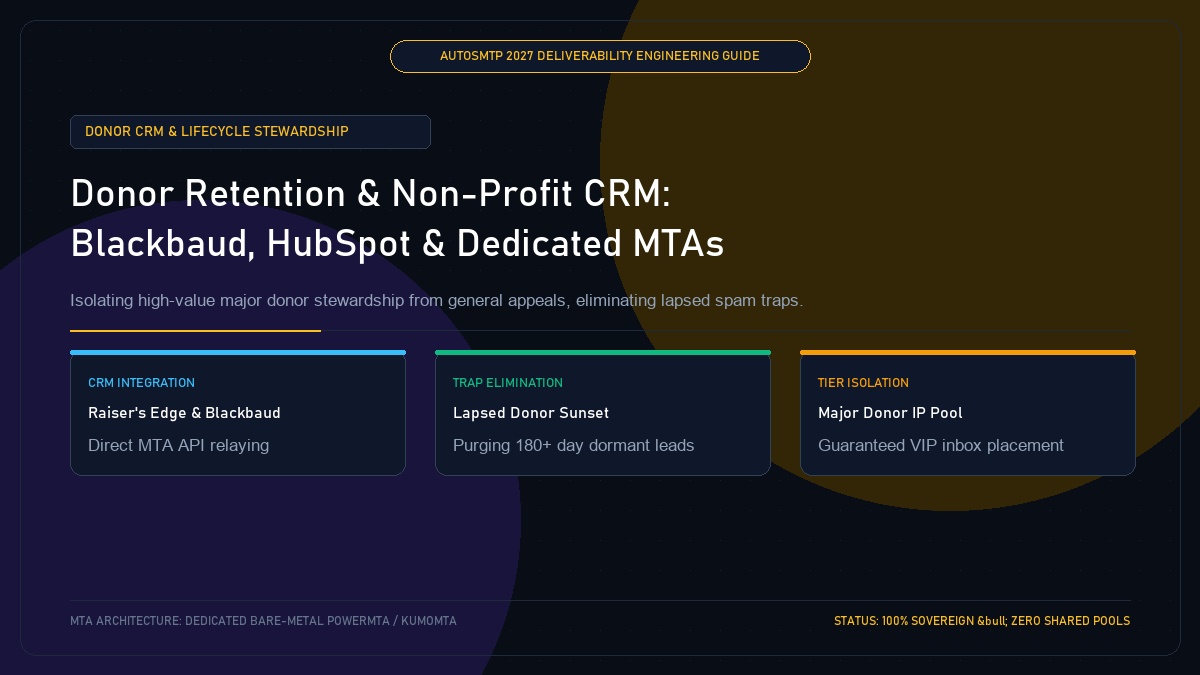
Non-profit organizations rely heavily on constituent relationship management (CRM) platforms such as Blackbaud Raiser’s Edge NXT, Salesforce Nonprofit Cloud, EveryAction, and HubSpot. While these platforms excel at tracking donor histories, pledge tiers, and pledge fulfillment, their default outbound email relays frequently route through multi-tenant, shared IP pools. As a result, critical donor communications—from major gift stewardship to monthly recurring receipts—suffer from delivery failures, greylisting, and spam folder placement. Aligning CRM workflows with dedicated MTA infrastructure is the foundation of high-retention donor stewardship.
- 1. Non-Profit CRM Bottlenecks: Shared Relays & Deliverability Blind Spots
- 2. The Lapsed Donor Danger: Recycled Spam Traps & Inactive Lists
- 3. Tiered Donor Segmentation: Major Giving vs. General Appeals
- 4. In-Band 550 Socket Interceptors: Real-Time Address Pruning
- 5. Bi-Directional CRM Webhook Architecture
- 6. Dedicated MTA Relay vs. Built-In CRM Dispatch Matrix
- 7. Case Study: Environmental Foundation Reclaims Major Gift Renewals
- 8. The AutoSMTP Non-Profit CRM Advantage
1. Non-Profit CRM Bottlenecks: Shared Relays & Deliverability Blind Spots
Leading non-profit CRMs are designed primarily as databases of record rather than high-performance mail transport agents. When an organization triggers donor communications through these platforms, the email is typically routed through shared third-party relay pools:
- Noisy Neighbor Contamination: Other organizations sharing the same relay IP that blast unverified lists or unsegmented gala invites cause the entire pool to be greylisted or rate-limited by Gmail and Microsoft 365.
- Lack of Granular Throttling: Most non-profit CRMs do not permit custom configuration of SMTP connection limits, backoff retry schedules, or per-destination connection pools.
- Delayed Failure Reporting: Asynchronous bounce reports often take 24 to 48 hours to update in the CRM database, during which additional mail continues to hit dead addresses.
Routing CRM outbound messages through a dedicated SMTP relay gateway powered by AutoSMTP provides complete control over sender reputation, authentication, and throughput.
2. The Lapsed Donor Danger: Recycled Spam Traps & Inactive Lists
Non-profit CRMs often contain decades of constituent history. Well-meaning development directors frequently attempt to “re-engage” donors who gave 3, 5, or 7 years ago. In the email deliverability ecosystem, sending to email addresses dormant for over 180 days is catastrophic:
Safe Constituent Hygiene Protocol
- Automated sunsetting of addresses unengaged for > 180 days.
- Pre-send verification of historical records via SMTP socket handshake.
- Two-way synchronization of opt-outs and complaints directly into CRM.
- Re-permissioning campaigns using low-volume dedicated warming pipes.
High-Risk Lapsed Campaign Pitfalls
- Recycled spam traps maintained by Spamhaus, Outlook, and Gmail.
- High hard-bounce ratios (> 5%) triggering instant ISP rate-limiting.
- Spam complaint rates surging above the 0.10% Google threshold.
- Permanent domain reputation destruction across corporate root domains.
3. Tiered Donor Segmentation: Major Giving vs. General Appeals
Major gift officers communicate with high-net-worth individuals who generate 80% of an organization’s philanthropic revenue. If a university or foundation’s domain reputation is degraded by mass direct mail appeals, a $500,000 gift agreement email sent from an executive will land directly in the donor’s junk folder.
Enterprise non-profit infrastructure isolates these distinct communication tiers across separate subdomains and dedicated IP addresses:
vip.charity.org— Major gifts, foundation grants, board correspondence (Pristine IP).giving.charity.org— Monthly recurring donors, direct donor appeals, receipting.news.charity.org— General newsletters, volunteer updates, annual reports.action.charity.org— Advocacy petitions, civic campaigns, event rsvps.
4. In-Band 550 Socket Interceptors: Real-Time Address Pruning
When an outbound SMTP server connects to a receiving MTA and receives a 550 5.1.1 User unknown response, waiting for an asynchronous Delivery Status Notification (DSN) risks sending subsequent messages to the same bad mailbox. Modern MTAs intercept these status codes in-band during the SMTP transaction and instantly suppress the address across the entire cluster.
# Dedicated SMTP Inbound Relay for Non-Profit CRM (Raiser's Edge / HubSpot)
<source 10.0.0.0/8>
    always-allow-relaying yes
    smtp-service yes
    default-virtual-mta vmta-crm-giving
</source>

<virtual-mta vmta-crm-giving>
    smtp-source-ip 162.251.122.169
    host-name giving.charity.org
    max-smtp-out 100
    max-msg-per-connection 50
</virtual-mta>

# Real-Time In-Band 550 Suppression Engine
<bounce-classifier>
    class-name hard-bounce 550 5.1.1, 550 5.1.2, 554 5.7.1
    class-name soft-bounce 421 4.7.0, 451 4.4.0, 452 4.2.2
</bounce-classifier>
5. Bi-Directional CRM Webhook Architecture
Maintaining data parity between the bare-metal mail transport agent and the non-profit CRM is critical. When a subscriber clicks an RFC 8058 one-click unsubscribe link or lodges a spam complaint via an ISP Feedback Loop (FBL), an automated webhook immediately tags the constituent record in the CRM as “Do Not Contact – Email,” preventing staff from mistakenly sending future mass appeals.
6. Dedicated MTA Relay vs. Built-In CRM Dispatch Matrix
| Capability | Standard Outbound CRM Relays | AutoSMTP Dedicated Bare-Metal CRM Gateway |
|---|---|---|
| IP Reputation Isolation | Shared among thousands of external non-profits | 100% Dedicated, private bare-metal IPv4 allocation |
| Major Donor Mail Protection | Shared across all marketing and event blasts | Strict VirtualMTA tiering (vip. vs action.) |
| In-Band 550 Bounce Pruning | Delayed DSN parsing (up to 48 hrs) | Real-time wire-level socket intercept and suppression |
| Custom DKIM Alignment | Often limited to CRM-managed selectors | Full 2048-bit DKIM key control with regular rotation |
| Deliverability Telemetry | Basic aggregate opens and bounces | Wire-level RFC 3463 logs, SNDS, and Postmaster APIs |
Conservation Foundation Recovers 28% Major Donor Renewal Growth
A national conservation charity with 140,000 active donors was experiencing declining response rates on major donor stewardship communications sent via their CRM. Diagnostic investigation revealed that general fundraising appeals containing outdated donor lists had caused the organization’s root domain to be flagged for high spam rates in Google Postmaster Tools (> 0.35%), causing executive emails to land in spam.
The foundation deployed an AutoSMTP dedicated MTA gateway, segregating high-tier donor stewardship onto a pristine virtual MTA (stewardship.conservation.org) and routing bulk appeals through a separate IP pool. Within 30 days, domain reputation returned to “High” status in Google Postmaster, and major donor renewal rates surged by 28%, securing $4.1M in recurring endowment funding.
Non-Profit CRM Implementation Blueprint
Immediate Step: Connect non-profit CRM outbound SMTP to an external dedicated bare-metal MTA relay rather than default shared cloud pools.
Subdomain Segmentation: Configure dedicated subdomains for Major Giving (vip.), Recurring Donors (giving.), and Advocacy (action.) to insulate critical gift revenue from bulk campaign volatility.
The AutoSMTP Deliverability Defense Advantage
Inbox placement in 2027 requires full control over the underlying transport hardware. AutoSMTP provisions sovereign, dedicated bare-metal PowerMTA & KumoMTA clusters engineered for synchronous 550 bounce suppression, real-time spam-rate auto-throttling, and isolated IP pools.
Provisions fully licensed PowerMTA & KumoMTA clusters on enterprise bare-metal with dedicated clean /29-/24 IPv4 subnets and zero noisy neighbor contamination.
Monitors Google Postmaster spam ratios (<0.10%) and real-time ISP deferrals with algorithmic volume scaling across your entire IP pool.
RFC 5321 in-band 550 bounce suppression, automated Yahoo/Outlook Complaint Feedback Loops (CFL), and instant bad-IP eviction.
Pre-configured forward and reverse DNS (PTR) per IP, SPF CIDR alignment, 2048-bit DKIM rotation, and strict DMARC enforcement.
Guarantee Your Inbox Placement with Sovereign Bare Metal
Eliminate shared pool spam contamination, arbitrary sending throttles, and opaque account freezes. Deploy an enterprise AutoSMTP cluster today.
Deploy Turnkey MTA Cluster →