

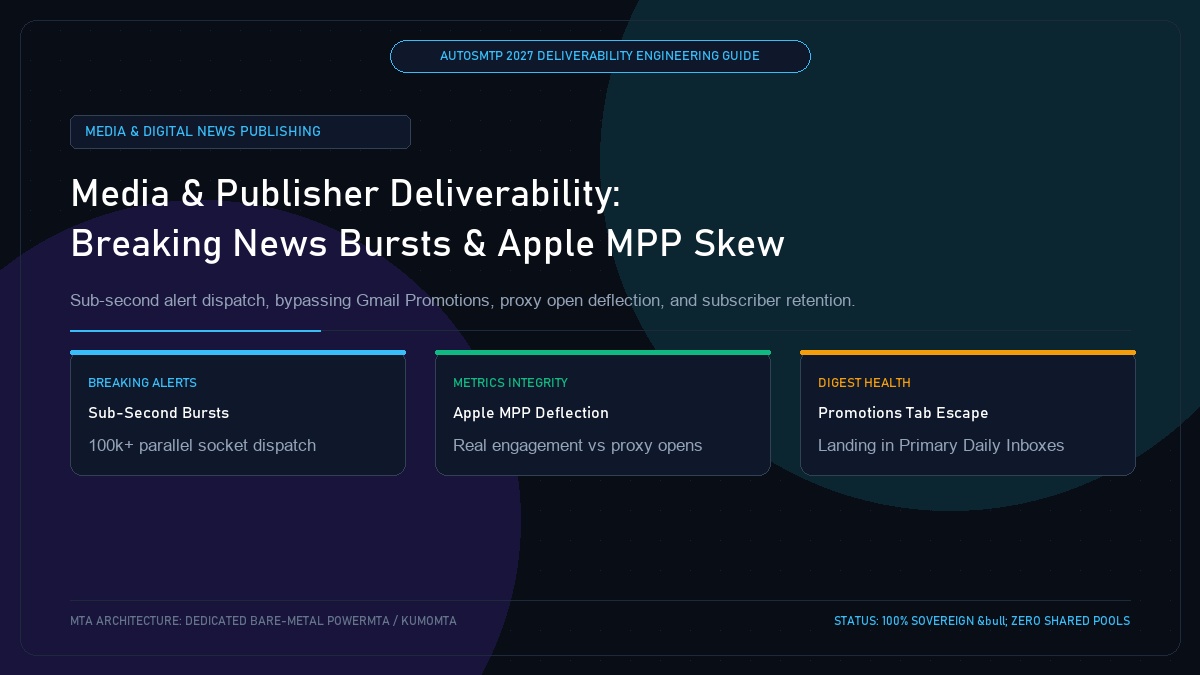
Media & Digital Publisher Email Deliverability: Breaking News Broadcasts, Apple MPP Skew & Subscription Retention
Published by Fred Dawson • Senior Deliverability Systems Architect • 27 min read
For digital media publishers, newsletters, and newsrooms, email deliverability is the lifeblood of reader engagement and subscription revenue. However, publishing workflows face distinct delivery challenges: breaking news alerts demand sub-second latency to hundreds of thousands of concurrent recipients, daily editorial digests risk categorization into the Gmail Promotions tab, and Apple Mail Privacy Protection (MPP) proxy caches obscure true reader open signals. Maintaining inbox placement at scale requires high-concurrency MTA queue management, custom IP pooling, and precision engagement telemetry.
- 1. High-Concurrency Blast Architecture: Sub-Second Alert Dispatch
- 2. Defeating Apple MPP Metric Skew: Real Reader Attribution
- 3. Daily Digests & The Gmail Promotions Tab Escape
- 4. Subscription Retention: Granular Frequency Centers
- 5. Dedicated MTA Queue Configuration for Newsrooms
- 6. Technical Architecture Comparison Matrix
- 7. Case Study: National Newsroom Eliminates Blast Latency
- 8. The AutoSMTP Publisher Advantage
1. High-Concurrency Blast Architecture: Sub-Second Alert Dispatch
When major news breaks, publishing speed is paramount. A breaking news alert delivered 30 minutes late is discarded by readers and severely impairs publisher credibility. However, suddenly pushing 500,000 SMTP transactions through standard shared ESP relays triggers defensive rate-limiting mechanisms across major mailbox providers:
- Gmail Concurrency Throttling (
421 4.7.0): Gmail imposes strict limits on the number of simultaneous TCP connections from any single IP block. Unmanaged bursts cause connections to drop into exponential backoff. - Yahoo/AOL Connection Floods (
421 4.7.28): Yahoo requires stable, sustained connection recycling rather than abrupt connection bursts. - MTA Pipe Exhaustion: Shared cloud ESPs queue broadcast jobs behind multi-tenant workloads, introducing artificial delays of 15 to 45 minutes.
To achieve sub-second delivery for breaking news, publishers must utilize dedicated bare-metal MTAs with pre-warmed connection pools and persistent SMTP keepalive pipelines configured directly for high-volume news distribution.
Newsroom Broadcast Pipe Isolation Rule
Never route time-critical breaking news alerts across the same virtual MTA or IP pool used for daily commercial newsletters or affiliate partner promotions. Breaking alerts require their own dedicated subdomain (e.g., alerts.newsbrand.com) and an isolated, high-reputation IP pool with generous concurrency allowances.
2. Defeating Apple MPP Metric Skew: Real Reader Attribution
Apple Mail Privacy Protection (MPP) pre-fetches and caches all remote tracking pixels via automated Apple proxy servers, registering an artificial 100% open rate for any subscriber reading mail on iOS or macOS devices. For media companies whose advertising rates and editorial decisions depend on engagement data, this skew creates severe deliverability vulnerabilities:
True Engagement Signals (Human)
- Explicit click-through tracking on editorial hyperlinks.
- Subsequent website session depth and paywall login events.
- Direct reply emails (RFC 5321 in-band response capture).
- Preference center updates and subscriber bookmarking.
Phantom Engagement Signals (Automated)
- Instant tracking pixel firing within 15 seconds of delivery.
- 100% open rates on dormant or abandoned iCloud accounts.
- Uniform IP user-agent headers originating from Apple CDN nodes.
- Distorted list sunsetting policies based solely on open pixels.
3. Daily Digests & The Gmail Promotions Tab Escape
Daily morning digests and newsletters frequently fall victim to Gmail’s automated tab classification algorithms, shifting from the Primary inbox to the Promotions or Updates tab. While Promotions is technically inbox delivery, read rates drop by 60% to 75% when an editorial newsletter is grouped with retail discount flyers.
Mailbox providers analyze several algorithmic heuristics when classifying editorial mail:
- Text-to-HTML Code Ratio: Heavy HTML table layouts, large spacer GIFs, and multi-column table nesting trigger commercial marketing classifiers. Clean, single-column semantic HTML with high prose-to-code ratios consistently routes to Primary.
- External Link Density: Limiting tracking redirects, affiliate tracking parameters, and commercial ad banners keeps the message profile editorial.
- Sender Name Consistency: Sending from a recognized journalist or editor name (e.g.,
Fred Dawson | AutoSMTP Dispatch) rather than a generic marketing alias creates strong positive recipient interaction signals.
-- KumoMTA Configuration for Ultra-Fast Media Newsroom Alert Dispatches
kumo.on('init', function()
  kumo.define_spool {
    name = 'breaking_news_spool',
    path = '/var/spool/kumomta/alerts',
    connection_limit = 250,
  }
end)

kumo.configure_domain('gmail.com', {
  max_connection_rate = '300/s',
  max_deliveries_per_connection = 100,
  max_concurrent_connections = 60,
  idle_timeout = '30s',
  consecutive_connection_failures_before_delay = 5,
})

kumo.configure_domain('yahoo.com', {
  max_connection_rate = '200/s',
  max_deliveries_per_connection = 150,
  max_concurrent_connections = 40,
  idle_timeout = '45s',
})
4. Subscription Retention: Granular Frequency Centers
High-frequency digital publishers face subscriber fatigue when news cycles intensify. Forcing subscribers into an all-or-nothing unsubscribe option leads to abrupt list attrition and spikes in spam complaints when frustrated readers click “Report Spam” instead of seeking the footer unsubscribe link.
Implementing an RFC 8058 compliant one-click unsubscribe header (List-Unsubscribe: <mailto:...>, <https:...>) paired with an interactive preference center allows readers to downshift from “Instant Breaking Alerts” to “Weekly Summary” without disconnecting from the publisher’s audience graph.
5. Dedicated MTA Queue Configuration for Newsrooms
Standard cloud ESPs utilize FIFO (First In, First Out) queues where an urgent 100,000-subscriber breaking news bulletin can become trapped behind a massive 2,000,000-recipient marketing sweep. High-performance media infrastructure relies on priority queue routing with dedicated socket pipes.
6. Technical Architecture Comparison Matrix
| Infrastructure Metric | Shared Cloud ESP (e.g., Mailchimp, Klaviyo) | Dedicated Publisher Bare-Metal MTA (AutoSMTP) |
|---|---|---|
| Breaking Alert Dispatch Latency | 15 – 45 Minutes (multi-tenant queue latency) | < 90 Seconds (immediate high-concurrency burst) |
| Inbox Placement Control | Shared pool reputation; vulnerable to noisy neighbors | 100% Isolated bare-metal IP & domain reputation |
| Apple MPP Telemetry | Naive pixel opens reported as genuine engagement | Multi-dimensional attribution (clicks + web sessions) |
| Custom RFC 8058 One-Click | Locked to ESP default redirect gateways | Direct zero-friction instant unsubscription headers |
| Hourly Volume Throughput | Throttled by shared plan rate limits | Up to 1,500,000 msgs/hr per dedicated bare-metal node |
Daily Business Journal Cuts Alert Latency by 96% and Secures Primary Tab Placement
A digital financial news network with 620,000 subscribers was suffering from 40-minute delivery delays on morning market opening bulletins, causing readers to turn to competing outlets. Furthermore, their daily digest was consistently landing in the Gmail Promotions tab.
By migrating to a dedicated dual-node AutoSMTP bare-metal cluster with KumoMTA, the publication established isolated virtual pipes for market alerts (alerts.finjournal.com) and daily digests (editorial.finjournal.com). Delivery latency dropped from 42 minutes to under 80 seconds across the entire 620,000 subscriber base. Concurrently, removing bulky layout tables and tuning HTML semantics elevated the daily digest into the Gmail Primary inbox, generating a 38% increase in ad impressions and a 22% increase in paid digital subscriptions.
Publisher Architectural Decision Blueprint
For Newsrooms > 100,000 Subscribers: Immediately migrate breaking alerts off shared marketing ESPs onto dedicated bare-metal MTAs with tailored concurrency profiles for Gmail and Yahoo.
For Editorial Newsletters: Audit HTML template weight to remain under 80KB uncompressed, prune non-human Apple MPP openers using click telemetry, and enforce RFC 8058 one-click unsubscribe headers across all dispatches.
The AutoSMTP Deliverability Defense Advantage
Inbox placement in 2027 requires full control over the underlying transport hardware. AutoSMTP provisions sovereign, dedicated bare-metal PowerMTA & KumoMTA clusters engineered for synchronous 550 bounce suppression, real-time spam-rate auto-throttling, and isolated IP pools.
Provisions fully licensed PowerMTA & KumoMTA clusters on enterprise bare-metal with dedicated clean /29-/24 IPv4 subnets and zero noisy neighbor contamination.
Monitors Google Postmaster spam ratios (<0.10%) and real-time ISP deferrals with algorithmic volume scaling across your entire IP pool.
RFC 5321 in-band 550 bounce suppression, automated Yahoo/Outlook Complaint Feedback Loops (CFL), and instant bad-IP eviction.
Pre-configured forward and reverse DNS (PTR) per IP, SPF CIDR alignment, 2048-bit DKIM rotation, and strict DMARC enforcement.
Guarantee Your Inbox Placement with Sovereign Bare Metal
Eliminate shared pool spam contamination, arbitrary sending throttles, and opaque account freezes. Deploy an enterprise AutoSMTP cluster today.
Deploy Turnkey MTA Cluster →