

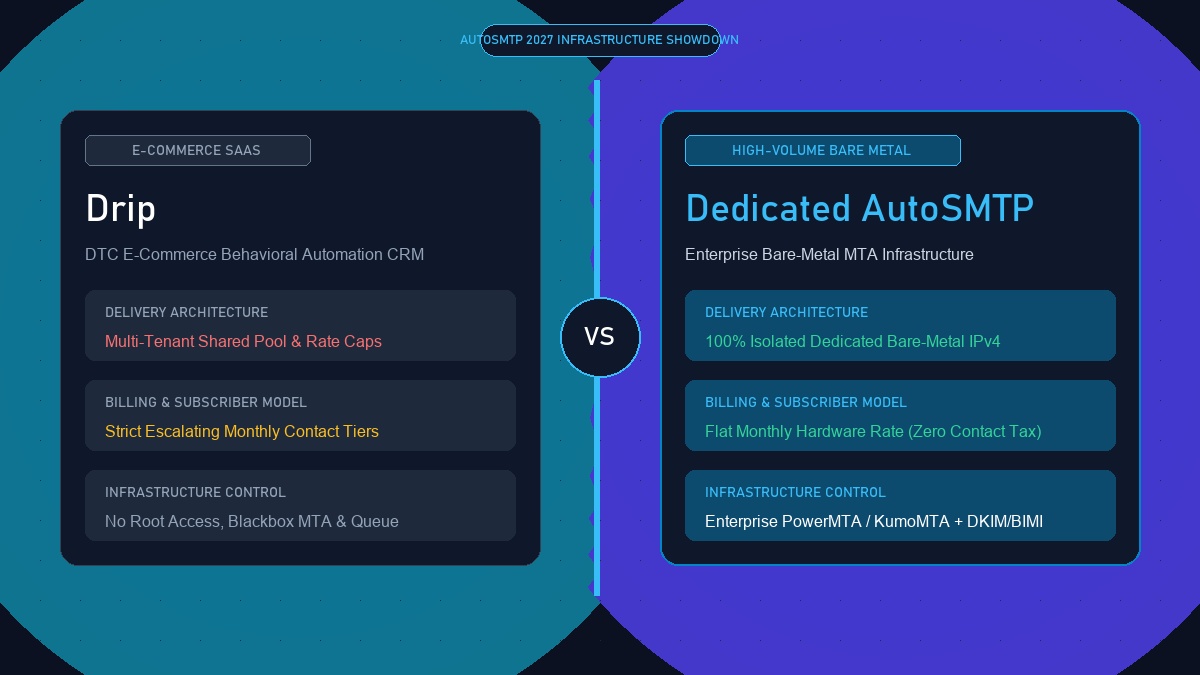
Drip vs Dedicated Infrastructure: 2027 Ecommerce Marketing Automation vs Sovereign MTAs
Executive Summary: Drip positions itself as the premier direct-to-consumer (DTC) ecommerce marketing automation platform, emphasizing deep integrations with Shopify, WooCommerce, and BigCommerce alongside visual revenue attribution workflows. However, Drip’s aggressive list-size pricing curve becomes an immense operational burden as stores grow: reaching 50,000 contacts costs $599/month, while 100,000 contacts skyrockets to $1,199/month ($14,388/year). Compounding this cost is the lack of dedicated MTA hardware and multi-tenant IP pool vulnerability. By decoupling ecommerce marketing workflows (via platforms like MailWizz or self-hosted automation hubs) from the underlying email engine using AutoSMTP Dedicated Infrastructure, brands retain their full customer databases with zero subscriber penalties, dedicated IPv4 subnets, raw RFC 5321 diagnostic visibility, and predictable flat-rate monthly costs.
- 1. 2027 Pricing Architecture: Single-Plan Model & The Contact Escalator
- 2. DTC Ecommerce Positioning: Shopify, BigCommerce & Sleeknote Synergy
- 3. Drip vs. Klaviyo: The Ecommerce Multi-Tenant Dilemma
- 4. Shared IP Deliverability & The Dedicated IP Barrier
- 5. Diagnostic Visibility: Drip Dashboards vs PowerMTA acct.csv
- 6. API Rate Limits & Ecommerce Webhook Ingestion
- 7. Side-by-Side 50K, 100K & 200K TCO Comparison Matrix
- 8. Production Case Study: UK Apparel Brand Saving $10,800/Year
- 9. 3-Phase Seamless Migration Architecture from Drip to AutoSMTP
- 10. Strategic Decision Framework & Platform Selection
1. 2027 Pricing Architecture: Single-Plan Model & The Contact Escalator
Unlike competitors that split features into Starter, Pro, and Enterprise tiers, Drip operates a unified single-plan model. Every user receives access to visual automation, segmentation, and reporting. However, this simplicity conceals a steep exponential pricing escalator based entirely on stored subscriber records:
- 2,500 Contacts: $39 / month
- 10,000 Contacts: $154 / month
- 25,000 Contacts: $359 / month
- 50,000 Contacts: $599 / month ($7,188 / year)
- 100,000 Contacts: $1,199 / month ($14,388 / year)
- 150,000 Contacts: $1,799 / month ($21,588 / year)
In ecommerce, subscriber lists naturally accumulate customer profiles over time: past purchasers, cart abandoners, one-time gift shoppers, and seasonal Black Friday browsers. Under Drip’s billing model, keeping a one-time buyer from two years ago costs just as much as keeping a high-LTV weekly repeat purchaser. To avoid spiraling fees, DTC brands are forced to aggressively purge past customers—destroying valuable retargeting data and seasonal reactivation opportunities.
2. DTC Ecommerce Positioning: Shopify, BigCommerce & Sleeknote Synergy
Drip’s primary strength lies in its tight integration with ecommerce platforms. Following its 2022 acquisition of Sleeknote (an advanced onsite popup and gamified lead-capture tool), Drip developed a coherent storefront-to-inbox workflow:
- Shopify & WooCommerce Webhook Triggers: Real-time event capture for cart abandonment, checkout initialization, and product page browsing.
- Visual Flow Builder: Multi-path branch logic that dynamically alters email sequences based on order value, discount code usage, and lifetime spend.
- Sleeknote Lead Capture: Seamless synchronization between website exit-intent popups, spin-to-win wheels, and automated drip sequences.
Turnkey Storefront Integrations: Pre-built 1-click connectors for Shopify, Magento, and WooCommerce without requiring custom API development.
Revenue Attribution Dashboards: Direct mapping of email clicks to store sales and average order value (AOV).
Combined Onsite & Email: Unified management of Sleeknote slide-ins, popups, and email drip sequences in one ecosystem.
Prohibitive Contact Tax: Reaching 100k+ subscribers costs over $14,000/year, penalizing brand growth and customer database retention.
Black-Box Multi-Tenant Delivery: Delivery routes through shared cloud pools; zero access to raw MTA routing tables or TLS socket handshakes.
No In-Band Bounce Diagnostics: Drip hides RFC 5321 SMTP transcript codes, leaving senders blind to specific ISP deferrals.
3. Drip vs. Klaviyo: The Ecommerce Multi-Tenant Dilemma
Ecommerce founders frequently compare Drip and Klaviyo. While Klaviyo dominates enterprise DTC with predictive analytics (predicted next purchase date, churn probability) and robust SMS marketing, Drip positions itself as the more straightforward, user-friendly alternative. However, both platforms suffer from the exact same fundamental economic flaw: contact-based lock-in.
As your store scales past 100,000 profiles, both platforms command four-to-five-figure monthly software bills. Neither platform gives you sovereign ownership of your mail transfer agent (MTA) or dedicated IPv4 routing tables. When Deliverability crises strike—such as Gmail or Microsoft 365 placing promotional campaigns into the spam tab—both platforms offer generic advice (“prune your inactive list”) rather than technical MTA-level remedies like VirtualMTA traffic shaping or custom connection throttling.
4. Shared IP Deliverability & The Dedicated IP Barrier
Unless an ecommerce brand qualifies for Drip’s custom enterprise contract, all transactional confirmations and marketing blasts are transmitted across Drip’s shared IP pools. If an affiliate marketer or dropshipper sharing the pool blasts an unscrubbed list and triggers Gmail’s 0.10% spam complaint ceiling, the entire IP reputation suffers. Your mission-critical order confirmations and cart abandonment alerts experience sudden throttling and spam-folder placement.
With AutoSMTP Dedicated Infrastructure, your store operates on dedicated bare-metal servers assigned clean, isolated IPv4 subnets. You retain 100% control over domain and IP reputation. Dedicated VirtualMTAs allow you to isolate transactional order receipts from promotional newsletters:
5. Diagnostic Visibility: Drip Dashboards vs PowerMTA acct.csv
When an abandoned-cart email fails on Drip, the platform dashboard displays a generic indicator: “Undelivered” or “Soft Bounced”. It cannot tell your engineering team whether the failure was caused by a transient DNS resolution timeout, a missing TLS 1.3 handshake cipher, or an in-band RFC 5321 policy rejection.
AutoSMTP dedicated clusters log the complete raw SMTP dialog for every message in real time. The exact response code, remote receiving IP, cipher suite, and socket latency are recorded:
6. API Rate Limits & Ecommerce Webhook Ingestion
Drip imposes a REST API rate limit of 100 requests per minute across its endpoints. During peak sales events like Black Friday, flash sales, or product drops, a high-volume Shopify store easily processes thousands of order webhooks and customer tag updates simultaneously. Drip’s API queues become backlogged or return HTTP 429 errors, delaying order confirmations and replenishment flows.
On AutoSMTP dedicated clusters, email injection is decoupled from third-party API rate limits. Ingestion occurs over high-performance local Unix sockets, direct SMTP pipes, or dedicated RabbitMQ queues capable of absorbing 50,000 to 200,000 messages per hour with sub-second delivery latency.
7. Side-by-Side 50K, 100K & 200K TCO Comparison Matrix
The table below highlights the dramatic total cost of ownership (TCO) difference between Drip’s contact-based SaaS billing and AutoSMTP’s flat-rate dedicated bare-metal infrastructure:
| Platform Attribute | Drip (Single Plan) | AutoSMTP Dedicated Infrastructure | Operational Advantage |
|---|---|---|---|
| 50,000 Contacts | $599 / month ($7,188/yr) | $249 / month ($2,988/yr) | AutoSMTP saves $4,200/yr (58% lower) |
| 100,000 Contacts | $1,199 / month ($14,388/yr) | $299 / month ($3,588/yr) | AutoSMTP saves $10,800/yr (75% lower) |
| 200,000 Contacts | $2,399 / month ($28,788/yr) | $399 / month ($4,788/yr) | AutoSMTP saves $24,000/yr (83% lower) |
| Monthly Email Limit | Scaled with contact tier | Unlimited Outbound Capacity | Zero overage charges or volume throttling |
| IP Reputation Insulation | Shared multi-tenant pool | Dedicated /29 clean IPv4 subnet | 100% domain and IP reputation ownership |
| Inactive Contact Pruning | Mandatory to prevent bill spikes | Unnecessary (zero storage cost) | Retain full historical customer data forever |
| SMTP Telemetry | Aggregated web percentages | Full RFC 5321 transcripts & DSNs | Microsecond ISP socket troubleshooting |
8. Production Case Study: UK Apparel Brand Saving $10,800/Year
How a DTC Fashion Retailer Replaced Drip, Eliminated Contact Taxes, and Boosted Deliverability
Background: A UK-based streetwear brand hosted on Shopify had grown its customer and prospect database to 98,000 contacts. Their monthly Drip bill climbed to $1,199/month ($14,388 annually). Whenever the marketing team launched a limited-edition sneaker drop, outbound emails took up to 3.5 hours to clear Drip’s shared sending queues, causing customers to complain that discount codes had expired before their emails arrived.
The Solution: In late 2026, the brand migrated its email engine to an AutoSMTP Dedicated PowerMTA cluster paired with a self-hosted MailWizz marketing automation frontend. Real-time Shopify purchase webhooks were redirected to the private frontend via native webhooks. Outbound traffic was mapped to two dedicated IPv4 addresses and warmed using AutoSMTP’s automated gas-pedal protocol over 18 days.
The Results:
- Massive Cost Savings: Annual email software expenditure plummeted from $14,388 to $3,588, generating direct savings of $10,800/year.
- Zero Queue Latency: The 98,000-subscriber drop announcement dispatched in under 12 minutes—a 17x speed improvement over Drip’s multi-tenant queues.
- Inbox Placement Gain: Primary inbox placement across Gmail and Outlook improved from 86.4% to 98.1% due to clean dedicated IP reputation and customized MTA throttling.
9. 3-Phase Seamless Migration Architecture from Drip to AutoSMTP
Migrating an active ecommerce business from Drip to AutoSMTP dedicated infrastructure requires zero downtime and guarantees customer data continuity:
Phase 1: Customer Data Export & List Scrubbing (Days 1–3)
Export all historical contacts, tags, and custom fields from Drip via JSON export or REST API. Run lists through AutoSMTP’s integrated verification engine to eliminate invalid domains, dormant accounts, and toxic spam traps accumulated from guest checkouts.
Phase 2: DNS Authentication & Automated Gas-Pedal Warmup (Days 4–18)
Configure dedicated rDNS/PTR, SPF records, 2048-bit DKIM keys, and strict DMARC alignment. Gradually shift VIP and high-engagement newsletter volume to the dedicated MTA using AutoSMTP’s automated IP ramp algorithm, monitoring Google Postmaster spam complaint ratios in real time.
Phase 3: Webhook Relinking & Full Queue Cutover (Days 19–21)
Connect Shopify/WooCommerce order webhooks directly to the private marketing frontend. Route all transactional triggers and broadcast campaigns through the dedicated MTA, safely cancelling the expensive Drip subscription.
10. Strategic Decision Framework & Platform Selection
Choose Drip If:
- Your store is brand new and holds fewer than 10,000 total customer contacts.
- You lack an engineer or technical marketer to manage a self-hosted marketing frontend.
- You rely exclusively on out-of-the-box Shopify plug-and-play visual automations.
- High-growth software licensing costs are not a primary business concern.
Choose AutoSMTP Dedicated If:
- Your customer database exceeds 50,000 records and Drip’s bills are eating into margins.
- You run flash sales or product drops requiring instant, burst-speed sending throughput.
- You want dedicated IP reputation completely insulated from noisy-neighbor spam.
- You require raw RFC 5321 diagnostic visibility to troubleshoot inbox placement issues.
Stop paying monthly contact penalties to SaaS marketing platforms. AutoSMTP delivers turnkey, fully managed dedicated bare-metal email clusters engineered for sovereign control, maximum throughput, and uncompromised inbox placement.
Provisions fully licensed PowerMTA/KumoMTA clusters on enterprise bare metal with flat, predictable pricing regardless of database contact size.
Monitors Google Postmaster spam ratios (<0.1%) and real-time deferrals across clean IPv4 subnets, ramping delivery automatically.
RFC 5321 in-band 550 bounce suppression + automated Yahoo/Outlook CFL ingest directly into suppression registries.
Pre-configured rDNS/PTR, SPF, 2048-bit DKIM, strict DMARC, and BIMI integration verified prior to cluster handoff.
Ready for Sovereign Dedicated Email Infrastructure?
Deploy enterprise bare-metal MTAs with dedicated IPs, automated IP warming, and flat-rate pricing. Eliminate the SaaS subscriber tax forever.
Explore Dedicated SMTP Clusters & Pricing →