

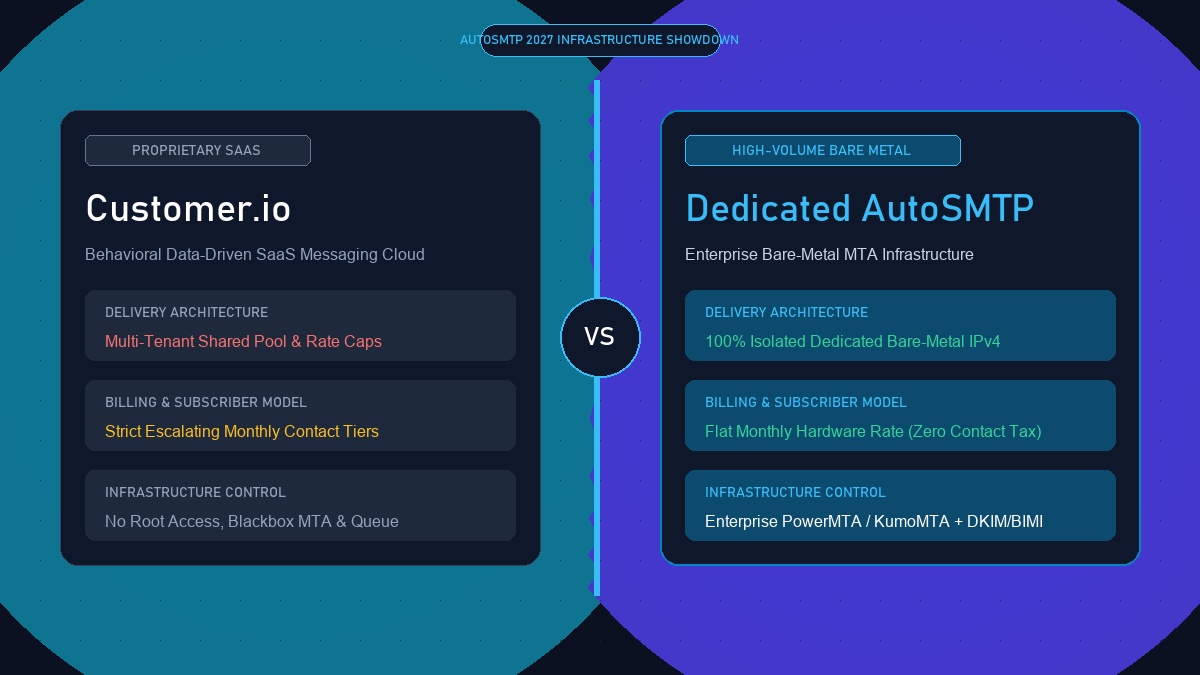
Customer.io vs Dedicated Infrastructure: 2027 Event-Driven Messaging Showdown
The architectural showdown between Customer.io and Dedicated Email Infrastructure examines the boundary between real-time behavioral product messaging and high-throughput transmission economics. Customer.io is an exceptional event-driven messaging cloud designed for product-led growth (PLG) SaaS platforms, streaming in-app user actions into automated onboarding workflows, push notifications, and transactional receipts. However, as product user bases surpass 100,000 profiles, Customer.io’s subscription tiers scale aggressively ($1,250+/mo on Essentials, $3,000+/mo on Enterprise) while delegating delivery to shared cloud relays. Dedicated bare-metal infrastructure provides unmetered profile capacity, private IP isolation, and multi-million message throughput at fixed hardware rates.
- 1. Behavioral Product Messaging vs Infrastructure Sovereignty
- 2. Customer.io’s Real-Time Event Pipeline
- 3. 2027 Profile Escalation & Surcharge Realities
- 4. Delivery Mechanics: Cloud Relays vs Private Bare Metal
- 5. The Dual-Tier Hybrid Architecture Pattern
- 6. Full Comparative Specification Matrix
- 7. B2B SaaS Platform Case Study
- 8. Strategic Decision Framework
1. Behavioral Product Messaging vs Infrastructure Sovereignty
Modern software companies maintain two distinct types of email communication:
- Product-Triggered Behavioral Messages: Real-time automated messages triggered by user behavior (e.g., `User Created Workspace`, `Invited Team Member`, `Export Failed`). These require stateful event streams and immediate socket dispatch.
- Broad Audience Communications: Product release digests, educational newsletters, re-activation announcements, and marketing broadcasts dispatched to your entire registered database.
Customer.io was engineered specifically for the first category. It ingests Segment and JSON event streams to trigger intricate liquid-template customer journeys. However, Customer.io bills for every user profile stored in your workspace—meaning dormant, cancelled, or free-tier users who signed up three years ago continue to incur monthly SaaS charges.
Dedicated Email Infrastructure solves the economic scaling dilemma. By routing high-volume digests, marketing sequences, and archival broadcasts through dedicated PowerMTA or KumoMTA clusters, companies eliminate profile surcharges entirely while preserving private IP deliverability.
2. Customer.io’s Real-Time Event Pipeline
Customer.io’s strength is its tight coupling with product analytics:
[ Customer.io Cloud Architecture ]
App Events (Segment / Webhook)
  --> Customer.io Journey Engine (Liquid Templating & Branching)
    --> Third-Party Cloud Relays (Mailgun / SendGrid shared pools)
      --> Recipient Inboxes (Subject to relay rate limits & shared reputation)

[ AutoSMTP Dedicated Architecture ]
App / Frontend (MailWizz / App Queue / API)
  --> Local Redis Spooler
    --> Dedicated Bare-Metal PowerMTA / KumoMTA Engine
      --> 100% Private Dedicated IPv4 Addresses (rDNS/PTR, 2048-bit DKIM, strict DMARC)
3. 2027 Profile Escalation & Surcharge Realities
Customer.io pricing is determined strictly by the number of tracked customer profiles. Free-tier SaaS products or mobile apps with high registration volume encounter exponential price escalations:
| Tracked User Profiles | Customer.io Essentials (Monthly) | Customer.io Enterprise Tier | Dedicated AutoSMTP Node | Annual Cost Advantage |
|---|---|---|---|---|
| 12,000 Profiles | $150 / mo | N/A | $49 / mo | Save $1,212 / yr |
| 50,000 Profiles | $550 / mo | $1,200 / mo | $99 / mo | Save $5,412 – $13,212 / yr |
| 100,000 Profiles | $1,250 / mo | $2,200 / mo | $149 / mo | Save $13,212 – $24,612 / yr |
| 250,000 Profiles | $2,600 / mo | $3,800 / mo | $249 / mo | Save $28,212 – $42,612 / yr |
| 1,000,000 Profiles | Custom ($8,500+) | Enterprise ($12,000+) | $449 / mo | Save $96,000 – $138,000+ / yr (95%) |
4. Delivery Mechanics: Cloud Relays vs Private Bare Metal
- Pure IP Reputation Isolation: Dedicated IPv4 addresses with matching rDNS, completely protected from external sender noise.
- Direct In-Band Bounce Control: In-band RFC 5321 550 bounce interceptors prevent database reputation decay.
- ISP-Specific Rate Tuning: Fine-tune maximum connections, socket timeouts, and hourly rates per destination ISP.
- Cryptographic Autonomy: Fully aligned 2048-bit DKIM, custom Return-Path, strict DMARC, and verified BIMI SVG logos.
- Default Shared Relay Pools: By default, Customer.io routes messages through shared Mailgun or SparkPost cloud pools.
- Custom SMTP Add-On Latency: Configuring external SMTP adds network round-trip latency to webhook execution loops.
- Automated Account Audits: Compliance algorithms flag accounts when high-volume reactivation broadcasts trigger bounces.
- No Root MTA Access: Inability to inspect raw SMTP session transcripts or adjust TCP window buffers.
5. The Dual-Tier Hybrid Architecture Pattern
Fast-growing SaaS and product companies frequently maximize ROI by deploying a two-tier hybrid email infrastructure:
- Tier 1 (Customer.io Essentials – 15,000 Profiles): Retained exclusively for high-intent, active product users undergoing complex onboarding and lifecycle flows.
- Tier 2 (AutoSMTP Dedicated Bare-Metal Node – Unlimited Database): Ingests all historical, free-tier, newsletter, and promotional subscribers via webhooks, handling multi-million broadcast sends at a flat $149/mo server cost.
This hybrid topology preserves Customer.io’s visual journey capabilities for active users while slashing gross software costs by over 75%.
6. Full Comparative Specification Matrix
| Evaluation Dimension | Customer.io (Behavioral SaaS) | Dedicated AutoSMTP Infrastructure |
|---|---|---|
| Core Specialization | Product-led growth (PLG) behavioral journeys & mobile push | High-volume mass broadcasts, transactional & newsletter MTA |
| Billing Model | Compounding monthly profile tiers ($1,250+/mo for 100k) | Flat monthly bare-metal hardware rate ($149/mo for 100k+) |
| MTA Engine | Cloud relay abstraction (Mailgun/SparkPost backend) | Enterprise PowerMTA, KumoMTA, or hardened Postfix |
| IP Allocation | Shared pool by default; dedicated IP requires custom tier | 100% Dedicated private IPv4 subnets with pristine historical reputation |
| Liquid Templating | Native advanced Liquid syntax with inline object loops | Standard tag merge variables + custom dynamic template hooks |
| Throughput & Concurrency | Platform queue limits and hourly rate throttling | Up to 500,000+ messages/hour per bare-metal node |
| Data Residency & Security | Multi-tenant US/EU cloud databases | 100% on-premise data sovereignty under your organizational control |
| Account Termination Risk | Automated compliance freezes on elevated bounce spikes | Zero risk; private infrastructure cannot be deactivated by a third party |
7. B2B SaaS Platform Case Study
Project Management SaaS Saves $32,400/Year with a Split Architecture
A cloud collaboration SaaS with 280,000 registered freemium users was paying over $3,100 per month on Customer.io. Over 80% of their database consisted of free-tier users who only received monthly product release summaries and security updates.
The engineering team split their email architecture:
- Customer.io was scaled down to 20,000 active paid workspace seats running automated onboarding journeys ($280/mo).
- All 280,000 freemium and historical users were migrated to an AutoSMTP Dedicated PowerMTA Bare-Metal Node paired with MailWizz ($189/mo).
- Total Monthly Cost: Dropped from $3,100/mo to $469/mo—an annual savings of $31,572 (85% reduction) while achieving faster broadcast completion times.
8. Strategic Decision Framework
You are a funded B2B or B2C SaaS product with under 25,000 active users, your marketing team depends heavily on visual behavioral journeys tied to Segment event tracking, and you require synchronized email, SMS, and in-app push notifications from a unified workflow builder.
You have a large database of freemium, historical, or newsletter subscribers exceeding 50,000 contacts, send regular promotional broadcasts, or demand dedicated IP reputation completely protected from outside spammers. AutoSMTP provides the speed, reliability, and economic advantages of enterprise bare-metal MTAs with zero administrative burden.
Deploy Dedicated Bare-Metal MTA Power
Stop paying profile surcharges for dormant users. AutoSMTP provisions dedicated NVMe bare-metal clusters powered by enterprise PowerMTA or KumoMTA, managed 24/7 by deliverability specialists.
Dedicated enterprise MTA engines on bare-metal NVMe servers with 100% private IPv4 subnets and zero shared resource contention.
Intelligent warmup pacing monitoring Google Postmaster spam ratios (<0.1%) and real-time deferrals across clean IPv4 subnets.
RFC 5321 in-band 550 bounce suppression and automated Yahoo/Outlook Complaint Feedback Loop processing directly into your sending queues.
Pre-configured rDNS/PTR, SPF, 2048-bit DKIM, strict DMARC, and BIMI SVG certificates managed 24/7 by deliverability specialists.
Stop paying subscriber penalties. Scale your email sending with dedicated bare-metal MTA power today.