

← Compliance & Legal Guides
EXECUTIVE REGULATORY BRIEFING
Published: October 2026 • Author: Fred Dawson • Deliverability & Legal Compliance Architecture

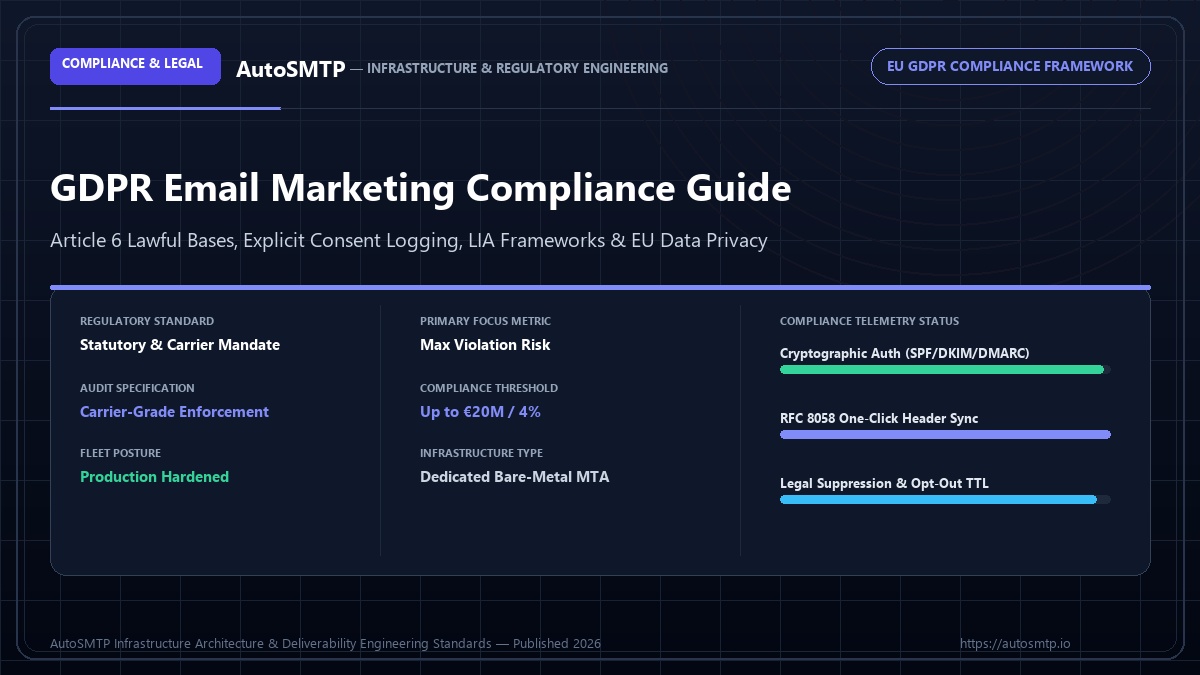
Executive Summary: Comprehensive guide to GDPR email compliance: Article 6 legal bases, consent vs legitimate interest (LIA), Article 7 consent logging, double opt-in, and cross-border data transfer compliance.

GDPR + ePrivacy Legal Framework Regulation (EU) 2016/679 & Directive 2002/58/EC
Article 7 Audit Trail Consent Logging Timestamp, IP, form URL & consent copy
€20M or 4% Turnover Statutory Ceiling Administrative financial penalties
Article 17 SLA Right to Erasure 30-day verified data deletion standard

GDPR’s impact on email marketing is often misunderstood. Marketers worry primarily about the consent question — do I need permission to email this person? — while missing the equally important questions around data retention, right of access, data processor agreements, and the technical infrastructure that handles personal data. This guide addresses all four, with specific attention to how EU-based dedicated email infrastructure differs from US-hosted ESPs in its GDPR compliance implications.

The legal basis for sending commercial email differs significantly between B2B (business email addresses) and B2C (consumer/personal email addresses) under GDPR’s interaction with the ePrivacy Directive.

B2C email to consumers at personal addresses typically requires explicit, freely given, specific, informed, and unambiguous consent under ePrivacy Article 13. A generic “I agree to terms and conditions” checkbox that bundles marketing consent does not meet the specificity requirement. Consent must be a separate, affirmative action specifically for marketing communications. You must also be able to demonstrate consent with a timestamp, IP address, and the specific consent text that was shown.

B2B email to business contacts at work email addresses operates under a different rule in most EU member states. The ePrivacy Directive allows B2B email marketing based on Legitimate Interest (GDPR Article 6(1)(f)) provided you: have conducted and documented a Legitimate Interest Assessment (LIA), the contact is relevant to your business offering, the email is clearly identifiable as commercial, and you provide an easy opt-out mechanism. The key caveat is that national implementation of ePrivacy varies — Germany requires opt-in for B2B email; France, Italy, and Spain allow legitimate interest for B2B with proper opt-out.

CountryB2C emailB2B emailKey local rule
GermanyOpt-in requiredOpt-in required (UWG §7)Strictest in EU — both B2B and B2C require prior consent
FranceOpt-in requiredLegitimate interest OKCNIL guidance: B2B LI acceptable with documented LIA
NetherlandsOpt-in requiredLegitimate interest OKACM: B2B cold email allowed with easy unsubscribe
SwedenOpt-in requiredLegitimate interest OKIMY guidance follows general ePrivacy B2B exception
UK (post-Brexit)Opt-in required (PECR)Corporate subscribers: soft opt-in OKICO: UK PECR applies, similar to EU with some differences

Valid GDPR consent for email marketing is not just a checkbox — it requires a technical implementation that records and stores proof of consent in a form that can be produced to a supervisory authority on request. The WP29 (now EDPB) guidelines on consent specify that you must be able to demonstrate: who consented, when they consented, what they were told at the time of consent, and how consent was obtained.

▶ Technical consent record — required fields
1
Subscriber identifier — email address (hashed or plain) plus any internal ID linking the record to the subscriber profile.
2
Consent timestamp — UTC timestamp of the consent action, to millisecond precision. Form submission timestamp for single opt-in; confirmation click timestamp for double opt-in.
3
IP address — the IP address from which the consent action was taken. Combined with timestamp, this enables cross-referencing with server logs if consent is challenged.
4
Consent text version — a hash or version ID of the exact consent language shown at the time of signup. Consent text changes must trigger re-consent if the change is material.
5
Source/method — the specific form, landing page URL, or acquisition channel where consent was obtained. Essential for audits of list segments.
6
Withdrawal record — when and how the subscriber withdrew consent (unsubscribe, FBL complaint, manual removal). Consent withdrawal must be as easy as giving consent.

Infrastructure and Data Residency

Where your email infrastructure is hosted determines where subscriber personal data is processed. Under GDPR, personal data transferred outside the EU/EEA requires either: the destination country has an adequacy decision from the European Commission, Standard Contractual Clauses (SCCs) are in place with the data processor, or another valid transfer mechanism applies.

Most major US-based ESPs (Mailchimp, Klaviyo, Salesforce Marketing Cloud, HubSpot) offer SCCs and GDPR-compliant data processing agreements. However, the Schrems II judgment (2020) invalidated the Privacy Shield framework and placed additional obligations on organisations conducting impact assessments for US data transfers. For organisations with EU-resident subscriber data, EU-hosted dedicated email infrastructure eliminates the transfer question entirely — there is no data export, no adequacy assessment required, and no risk from future regulatory changes affecting US-EU data transfer frameworks.

Right of Access and Right to Erasure

GDPR Articles 15 and 17 give subscribers the right to request a copy of their personal data held by your organisation (Subject Access Request) and the right to have their data deleted (Right to Erasure/Right to be Forgotten). Both rights apply to email marketing data. A subscriber can request to see all data you hold about them — including email addresses, consent records, campaign engagement history, suppression list entries, and any preference data — and can request complete deletion.

For email operations, erasure requests present a specific challenge: suppression lists contain email addresses specifically to prevent future sending. If you erase an address from your suppression list in response to an erasure request, you lose the record that prevents re-adding that address to future list imports. The EDPB guidance addresses this: you may retain a minimal record (typically just the hashed email address and a flag indicating it was erased/opted-out) in your suppression system for the sole purpose of preventing re-addition. This is consistent with both the erasure right and your legitimate interest in honoring the original opt-out.

📋 Client case — SaaS platform, regulatory audit, 180K EU subscriber list

Situation: French CNIL audit following a subscriber complaint about receiving marketing email without recollection of consenting. The client needed to produce consent records for 23 specific subscribers named in the complaint.
Consent documentation state: Single opt-in with no timestamp or IP logging. Only record was the email address in the database. No LIA documentation for B2B contacts.
Outcome: CNIL issued a formal warning and required implementation of consent logging within 90 days. No fine in this instance due to first-time offence and prompt remediation. Client implemented double opt-in with full consent logging, suppression list management, and a documented LIA for B2B outreach. Reconfirmation campaign to existing list: 64% re-confirmed, 36% suppressed.
Cost of compliance retrofit: Significantly higher than building it in from the start. The reconfirmation campaign alone reduced the active list from 180K to 115K — a 36% reduction in list size that could have been avoided with compliant acquisition practices from the beginning.

Last updated: March 22, 2026

Every commercial email sent to EU recipients must contain a visible, easy-to-use unsubscribe mechanism. Under ePrivacy Article 13 and GDPR’s data minimisation principle, the unsubscribe must be: present in every message (not just periodic mailings), functional immediately (not subject to a processing delay), and honoured globally (opting out in one channel must suppress sending across all channels from the same controller).

The one-click unsubscribe requirement from Gmail’s and Yahoo’s February 2024 bulk sender requirements aligns with GDPR’s “as easy as giving consent” principle. Technically, one-click unsubscribe means the recipient can opt out with a single action — no confirmation page, no password required, no reason selection required. The List-Unsubscribe-Post header enables email clients to surface a native unsubscribe button. For EU compliance, this is now the expected minimum standard, not an optional enhancement.

One-click unsubscribe headers — GDPR and bulk sender compliant
rfc8058-headers.txt (One-Click Headers) Console / Policy
# These headers must be present on all bulk commercial email:
List-Unsubscribe: <https://yourapp.com/unsubscribe?token=TOKEN>, <mailto:unsub@yourapp.com?subject=unsubscribe>
List-Unsubscribe-Post: List-Unsubscribe=One-Click

# The One-Click header enables Gmail/Yahoo to show a native Unsubscribe button
# The token must uniquely identify the subscriber — do not use bare email addresses
# Processing must happen immediately on POST to the unsubscribe URL
# Log the unsubscribe event with timestamp for GDPR compliance records

Data Processing Agreements — What to Verify

Article 28 requires a DPA with every third party that processes personal data on your behalf. For email operations, this includes your MTA hosting provider, your ESP, your email verification service, and any analytics tools that receive recipient data. Not every provider offers a GDPR-compliant DPA automatically — some require a request, some only offer DPAs on paid tiers, and some have DPAs that are inadequate in specific areas.

The critical DPA provisions to verify: the sub-processor list and notification requirement (you must be notified before new sub-processors are added), the data transfer mechanism for non-EU processors (SCCs or adequacy), the security measures section (encryption at rest and in transit, access controls), and the deletion/return clause (on termination, your data must be deleted or returned within a defined period — typically 30 days). Any DPA that lacks these provisions or includes vague language on transfer mechanisms should be escalated to your legal team before relying on that vendor for EU personal data processing.

GDPR Email Compliance Audit Checklist

Use this checklist quarterly to verify your email programme remains compliant as sending practices evolve, subscriber lists grow, and new tools are added to your technology stack.

☐
Consent records complete

Every subscriber has a logged consent record with timestamp, IP, form URL, and consent text version.

☐
DPAs current with all processors

Signed DPAs in place with: email infrastructure provider, ESP, email verification service, analytics tools receiving recipient data.

☐
Unsubscribe mechanism functional

One-click unsubscribe present and working in all commercial emails. Opt-outs processed within minutes, not days.

☐
Suppression list integrity

Unsubscribes, FBL complaints, and manual opt-outs are applied globally across all sending systems, not per-campaign.

☐
Data transfer mechanisms documented

For any US or non-EU processor handling EU personal data, SCCs or adequacy decision is documented and current.

☐
Retention policy applied to email data

Inactive subscriber data and engagement history older than your retention policy (typically 2–3 years after last activity) is regularly purged.

GDPR Legitimate Interests: The B2B Email Exception

GDPR’s consent requirement for email marketing is widely understood, but the legitimate interests basis (Article 6(1)(f)) is less commonly applied correctly in B2B email contexts. For B2B senders contacting professionals about products or services relevant to their professional role, legitimate interests can provide a valid lawful basis without requiring explicit opt-in consent — if a proper Legitimate Interests Assessment (LIA) is documented.

The LIA three-step test: (1) Purpose test — is the processing for a legitimate purpose? B2B marketing of relevant professional services to decision-makers generally qualifies. (2) Necessity test — is processing necessary for that purpose? Email is an efficient and proportionate way to communicate with business contacts. (3) Balancing test — do the legitimate interests override the data subject’s rights? This is where B2B email legitimate interests is most defensible: business contacts have a reduced expectation of privacy in their professional email addresses compared to personal addresses, and they can reasonably expect to receive professionally relevant communications at those addresses.

The LIA must be documented — not just concluded. Create a written LIA for each B2B email category (outreach to marketing decision-makers, outreach to IT procurement contacts, etc.) that explicitly addresses all three tests with the specific rationale for each. Store these LIAs with version history and review dates. When a DPA investigation occurs (triggered by a recipient complaint), the documented LIA is the evidence that the processing had a valid lawful basis. The LIA provides no protection if it was never written down or was created after-the-fact during the investigation.

GDPR also requires that B2B email under legitimate interests includes an opt-out mechanism (even without prior consent, the recipient must be able to object to further processing) and that the company’s legitimate interests are mentioned in the email. A brief disclosure — “We contacted you because your role as [title] at [company] indicates potential interest in [relevant service]” — satisfies the transparency requirement and demonstrates that the targeting was purposeful rather than arbitrary.

Production Deliverability & Legal Recommendation

Regulatory compliance is an architectural guarantee, not merely a policy checkbox. Attempting to manage compliance risks through shared email pools or manual suppression spreadsheets inevitably results in statutory exposure, ISP rate limits, and carrier-level blocklisting. Enterprise senders must maintain complete physical IP isolation, cryptographic DNS alignment, and automated in-band suppression processing across dedicated bare-metal MTA infrastructure.

Compliance Engineering Roadmap

Step 1 (Cryptographic & Header Alignment): Enforce strict DMARC (p=reject), FCrDNS reverse pointers, and RFC 8058 one-click List-Unsubscribe headers.
Step 2 (Audience & Suppression Sync): Implement automated webhook hooks to suppress opt-outs and invalid recipients instantly across all fleet nodes.
Step 3 (Continuous Telemetry & Archival): Ingest real-time ISP feedback loops (Google Postmaster, Microsoft SNDS, Yahoo CFL) and maintain tamper-proof, immutable delivery logs.

FD
Fred Dawson

Deliverability Architect & MTA Systems Engineer at AutoSMTP. Specialises in dedicated MTA cluster design, carrier-grade IP warming protocols, and ISP reputation telemetry across high-volume sending fleets.

Enterprise Mail Infrastructure

The AutoSMTP Dedicated Outreach Fleet Advantage

AutoSMTP provisions and manages enterprise-grade PowerMTA and KumoMTA clusters on dedicated bare-metal servers. Complete domain isolation, automated gas-pedal warming, and proactive deliverability telemetry.

Turnkey Dedicated Bare-Metal Clusters

Pre-configured PowerMTA and KumoMTA installations on enterprise hardware with dedicated IPv4 subnets and predictable flat pricing.

Automated Gas-Pedal IP Warming

Dynamic ramp-up algorithms that modulate hourly dispatch volume against real-time deferrals and Google Postmaster spam ratios.

Native FBL & Socket Interceptors

Automated RFC 3464 bounce ingestion, Yahoo/Outlook CFL complaint webhooks, and instant in-band suppression sync across all fleet nodes.

Strict Cryptographic Alignment

2048-bit DKIM key rotation, strict DMARC enforcement (p=reject), FCrDNS PTR verification, and automated TLS cipher hardening.

Ready for Dedicated Sending Infrastructure?

Eliminate shared pool throttle penalties and take complete control over your mail delivery with custom-tuned MTA clusters.

Deploy Dedicated MTA Fleet →