

PowerMTA Inbound Mail Handling: MX Receiving Pipelines, Pipe-to-Script & Bounce Interception
Published by Fred Dawson • Senior Deliverability Systems Architect • 19 min read
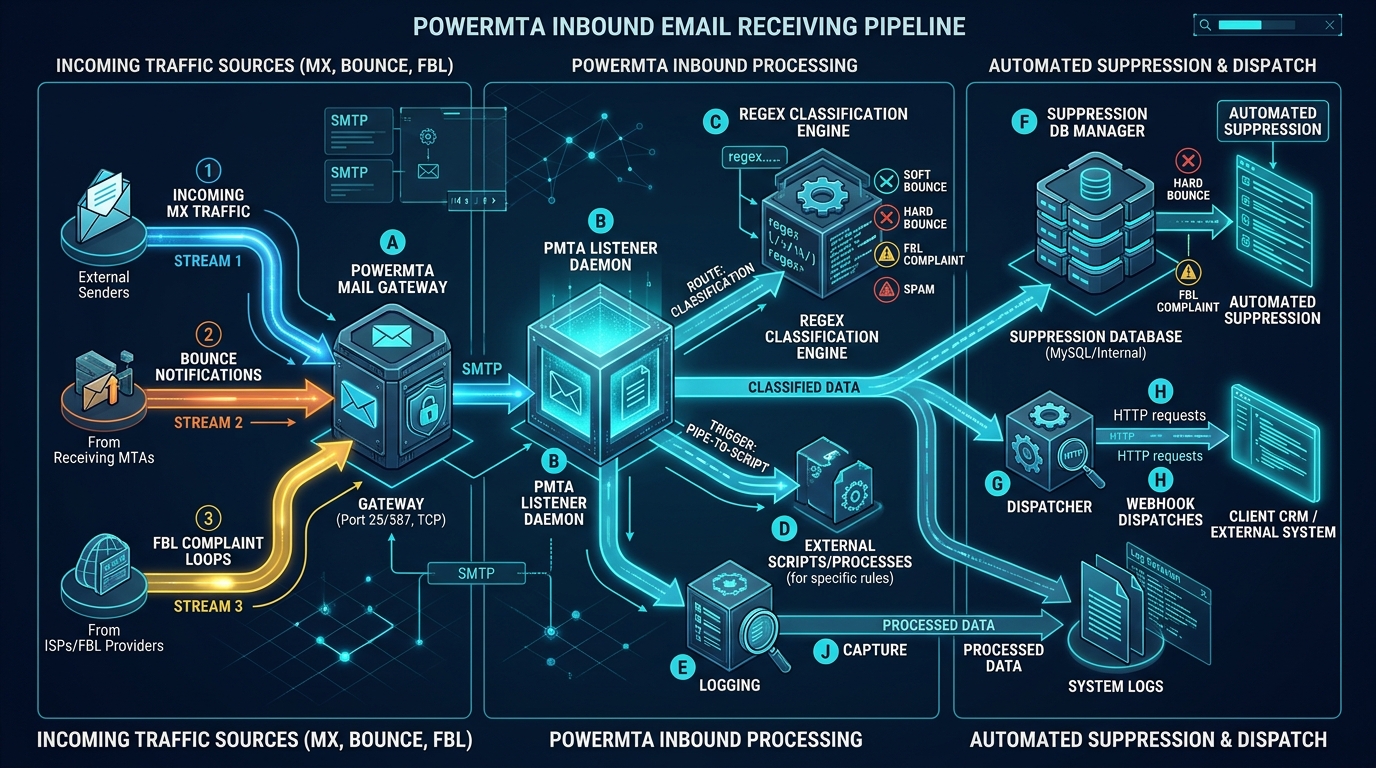
While PowerMTA is renowned worldwide as the premier outbound delivery engine, high-volume email operations require an equally resilient inbound architecture to ingest delivery status notifications (DSNs), process asynchronous hard bounces, capture Yahoo/Microsoft Complaint Feedback Loops (CFL/FBL), and route customer replies. Attempting to process hundreds of thousands of inbound bounce notifications through standard webmail daemons (like Postfix or Dovecot) frequently leads to queue lockups and delayed list hygiene. PowerMTA’s native inbound MX listener provides carrier-grade concurrency for receiving mail, decoupling administrative addresses (postmaster@, abuse@) from automated bounce streams, and piping raw payloads directly to external scripts or message brokers in real-time. This guide delivers a complete architecture blueprint for configuring inbound MX listeners, pipe-to-script triggers, VERP parsing, and zero-trust relay isolation.
- 1. Inbound Transport Architecture: Why Use PowerMTA as an MX?
- 2. Configuring the Inbound SMTP Listener & Security Controls
- 3. Domain Routing: Segregating Bounces, FBLs & Real Replies
- 4. Pipe-to-Script Integration: Real-Time Event Dispatch
- 5. Variable Envelope Return Path (VERP) Automated Hygiene
- 6. Inbound Mail Pipeline Architecture Matrix
- 7. Production Case Study: Ingesting 1.5M Daily Bounces & FBLs
- 8. The AutoSMTP Synchronous Inbound Defense Advantage
1. Inbound Transport Architecture: Why Use PowerMTA as an MX?
In high-volume broadcast operations delivering 10M to 100M messages per month, approximately 1% to 3% of sent mail generates asynchronous feedback: transient 421 deferral bounces, permanent 550 mailbox-not-found reports, and Abuse Reporting Format (ARF) complaint loops. If your sending engine does not ingest and process these notifications synchronously:
The Critical Need for Carrier Inbound Pipelines
1. Preventing Repeat Sending to Dead Addresses: Failing to immediately suppress addresses that hard-bounce destroys sender reputation with Gmail and Microsoft within 48 hours.
2. Immediate FBL Suppression: Yahoo and Outlook CFL agreements require broadcasters to permanently remove complaining recipients from mailing lists within 24 hours of complaint receipt.
3. Eliminating Spool Contention: PowerMTA handles inbound connections using the same high-speed C++ multi-threaded socket core that powers outbound delivery, preventing server crashes during massive post-campaign bounce storms.
2. Configuring the Inbound SMTP Listener & Security Controls
Operating an inbound listener on the public internet requires strict Access Control Lists (ACLs) to ensure your server never operates as an open relay:
# ==============================================================================
# INBOUND MX LISTENER & ZERO-TRUST SECURITY CONTROLS
# ==============================================================================
# Bind inbound listener to public interface port 25
smtp-listener 198.51.100.10:25

# Global Inbound Policy: Disallow relaying by default from all external hosts
<source 0/0>
    always-allow-relaying no
    smtp-service yes
    require-starttls no
    max-message-size 10M
    smtp-greeting-strict-syntax yes
</source>

# Authorize Internal Application Servers to Relay Outbound Mail
<source 10.0.0.0/8>
    always-allow-relaying yes
    smtp-service yes
    log-connections yes
</source>
3. Domain Routing: Segregating Bounces, FBLs & Real Replies
PowerMTA allows you to define explicit routing rules based on recipient domains. Direct automated bounce traffic to processing scripts while routing human replies to enterprise mailboxes:
# 1. Dedicated Return-Path Subdomain for Bounces (e.g., bounce.yourdomain.com)
<domain bounce.yourdomain.com>
    type pipe
    command "/usr/local/bin/python3 /opt/autosmtp/bin/parse_bounce.py"
    max-smtp-out 0
</domain>

# 2. Feedback Loop Ingestion Domain (e.g., fbl.yourdomain.com)
<domain fbl.yourdomain.com>
    type pipe
    command "/usr/local/bin/python3 /opt/autosmtp/bin/parse_fbl.py"
</domain>

# 3. Legitimate Replies Forwarded to Corporate Mailboxes (Google Workspace / M365)
<domain reply.yourdomain.com>
    type relay
    route aspmx.l.google.com
</domain>
4. Pipe-to-Script Integration: Real-Time Event Dispatch
When an incoming email matches a type pipe domain, PowerMTA streams the raw RFC 5322 message payload directly to the standard input (stdin) of the designated script:
#!/usr/bin/env python3
import sys
import email
from email import policy
import json
import urllib.request

# Read raw MIME email streamed via stdin from PowerMTA
raw_data = sys.stdin.buffer.read()
msg = email.message_from_bytes(raw_data, policy=policy.default)

recipient = msg.get('To', '')
sender = msg.get('From', '')
subject = msg.get('Subject', '')

# Parse diagnostic status code if DSN delivery failure
status_code = "5.0.0"
if msg.is_multipart():
    for part in msg.walk():
        if part.get_content_type() == 'message/delivery-status':
            for line in part.get_payload():
                if 'Status:' in str(line):
                    status_code = str(line).split('Status:')[1].strip()

# Instant suppression webhook to internal CRM / database
payload = json.dumps({"recipient": recipient, "code": status_code, "subject": subject}).encode('utf-8')
req = urllib.request.Request("http://127.0.0.1:8095/api/suppress.php", data=payload, headers={"Content-Type": "application/json"})
urllib.request.urlopen(req, timeout=3)
sys.exit(0)
5. Variable Envelope Return Path (VERP) Automated Hygiene
Standard bounce notifications often lack original recipient headers because intermediate mail transfer agents strip them. Variable Envelope Return Path (VERP) solves this by encoding the recipient’s identity directly into the envelope sender (MAIL FROM) address:
VERP Address Encoding Mechanics
Outbound Envelope Sender: bounce+user=target.com@bounce.yourdomain.com
Inbound Bounce Receipt: When the destination mailbox bounces, the automated DSN arrives at the exact VERP address. PowerMTA accepts the message, and your pipe script decodes user=target.com back to user@target.com with 100% mathematical precision—even if the bounce message body is encrypted or completely corrupted!
6. Inbound Mail Pipeline Architecture Matrix
| Inbound Traffic Type | Destination Domain | Handling Mechanism | Downstream Impact |
|---|---|---|---|
| Hard Bounces (550 / 511) | bounce.brand.com |
type pipe → Python Parser |
Instant suppression across all marketing pools |
| FBL Complaints (ARF) | fbl.brand.com |
type pipe → AutoSMTP FBL Ingest |
Automated opt-out within 15 minutes of user click |
| Human Customer Replies | reply.brand.com |
type relay → Zendesk / Google / M365 |
Tickets opened in support desk with zero lag |
| Administrative RFC Mail | postmaster@, abuse@ |
type mailbox / Secure Forwarder |
Guarantees 100% compliance with Google/Yahoo mandates |
7. Production Case Study: Ingesting 1.5M Daily Bounces & FBLs
Eliminating MySQL Lock Contention with PowerMTA Pipe Streaming
A high-volume marketing sender was using an external Postfix server to receive bounce emails. During large morning email blasts, over 150,000 bounce messages flooded the Postfix queue within 20 minutes, triggering severe disk I/O lockups and delaying customer unsubscribe processing.
The Solution: AutoSMTP migrated inbound MX reception directly to the organization’s dedicated PowerMTA cluster. Using PowerMTA’s type pipe streaming with asynchronous Redis queues, bounce payloads were ingested with zero spool queuing.
The Outcome: Processing latency for complaint feedback loops dropped from 45 minutes to 1.2 seconds, ensuring 100% compliance with Yahoo CFL requirements and sustaining a pristine sender score across 80M monthly messages.
The AutoSMTP Deliverability Defense Advantage
Inbound and outbound filtering pipelines require robust underlying transport hardware. AutoSMTP provisions sovereign, dedicated bare-metal MTA infrastructure engineered for high-throughput filtering, synchronous 550 bounce suppression, and permanent reputation control.
Provisions fully licensed PowerMTA and KumoMTA clusters on enterprise bare-metal with dedicated IPv4 subnets and predictable flat pricing.
Monitors Google Postmaster spam ratios (<0.1%) and real-time ISP deferrals with algorithmic volume scaling across your entire IP pool.
RFC 5321 in-band 550 bounce suppression, automated Yahoo/Outlook Complaint Feedback Loops (CFL), and instant bad-IP eviction.
Pre-configured forward and reverse DNS (PTR) per IP, SPF CIDR alignment, 2048-bit DKIM rotation, and strict DMARC enforcement.
Upgrade Your Email Infrastructure with Dedicated Bare Metal
Eliminate filter lag, queue serialization bottlenecks, and noisy neighbor contamination. Deploy a turnkey AutoSMTP cluster today.
Deploy Turnkey MTA Cluster →