

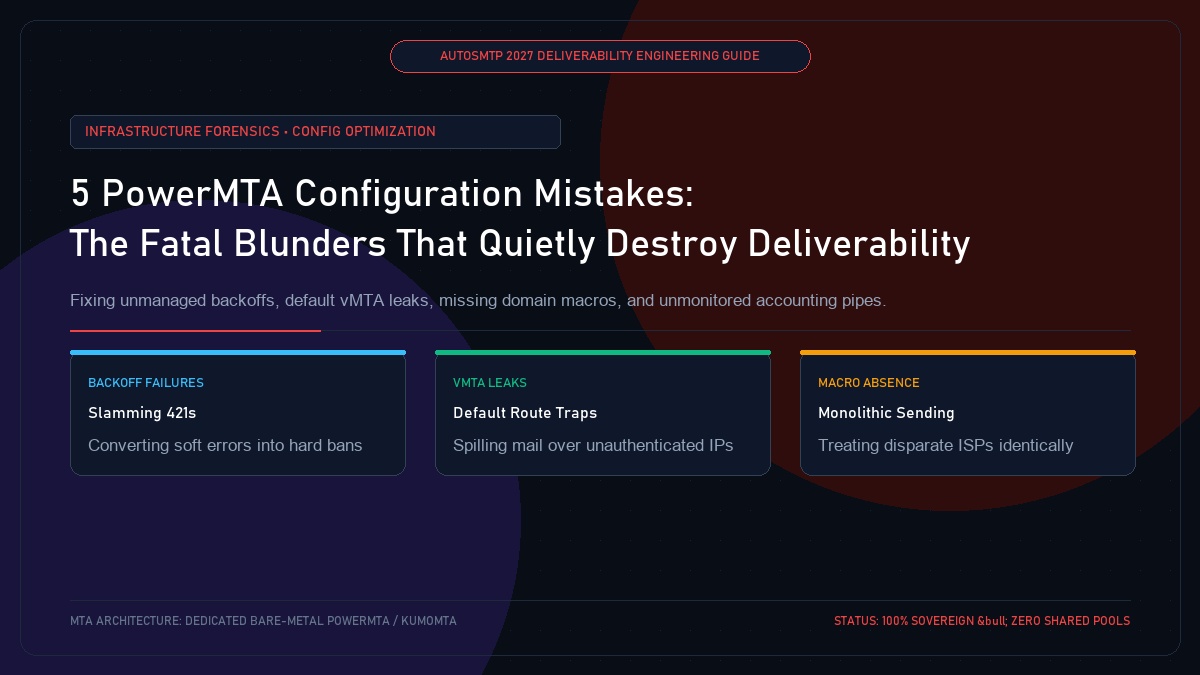
5 PowerMTA Configuration Mistakes: The Fatal Blunders That Quietly Destroy Deliverability
Published by Fred Dawson • Senior Deliverability Systems Architect • 25 min read
PowerMTA is widely regarded as the gold standard of high-volume mail transfer agents, celebrated for its raw performance, granular wire control, and robust stability. However, this immense power is a double-edged sword: minor configuration oversights that go unnoticed in low-volume relays will quietly dismantle deliverability at enterprise scale. Many operations teams treat PowerMTA as a set-and-forget relay, inheriting default settings that slam ISP receiving limits, leak mail over unauthenticated interfaces, or drop critical retry traffic. This architectural guide exposes the five most dangerous PowerMTA configuration blunders and provides battle-tested production fixes.
- 1. The Myth of the “Set-and-Forget” PowerMTA Relay
- 2. Mistake 1: Unmanaged or Static Backoff Retries (Converting 421s to Hard Bans)
- 3. Mistake 2: Leaking Mail Over Default Unauthenticated Virtual MTAs
- 4. Mistake 3: Monolithic Sending Without ISP-Specific Domain Macros
- 5. Mistake 4: Unmonitored Accounting Pipes & Missing FBL Ingestion
- 6. Mistake 5: Static Cryptographic Keys & Broken Reverse DNS Alignment
- 7. Configuration Remediation Matrix: Fatal Error vs Production Fix
- 8. Case Study: Healthcare Platform Halts 50% Deferrals by Auditing 5 Core Errors
- 9. The AutoSMTP Strategic Advantage
1. The Myth of the “Set-and-Forget” PowerMTA Relay
Too many enterprise sending environments treat an MTA deployment like a standard Linux utility: configure it once, start the service, and ignore it until alarms ring. In reality, mailbox provider algorithms evolve continuously. An MTA configuration that achieved 99% inboxing three years ago will fail today because modern ISPs actively test connection pacing, TLS versions, and backoff discipline.
2. Mistake 1: Unmanaged or Static Backoff Retries (Converting 421s to Hard Bans)
The Mistake: Omitting dynamic backoff directives or leaving retry-after at default values (e.g., 5m) without rate reduction. When Yahoo or Gmail responds with 421 4.7.0 Rate limit exceeded, the unconfigured MTA aggressively retries at full speed.
The Consequence: The receiving ISP escalates the soft throttle into an IP ban or 24-hour blocklist.
The Fix: Configure backoff-to-normal-after and backoff-max-msg-rate to automatically halve throughput during rate events.
3. Mistake 2: Leaking Mail Over Default Unauthenticated Virtual MTAs
The Mistake: Failing to bind inbound relay sources to explicit virtual MTAs. When an application submits mail without an X-Virtual-MTA header, PowerMTA defaults to the server’s primary network interface (eth0 IP).
The Consequence: Sensitive transactional mail or marketing broadcasts spill over the management IP, which lacks SPF records, PTR records, or warming history, triggering immediate 550 rejections.
The Fix: Explicitly disable the default virtual MTA or enforce strict source routing.
4. Mistake 3: Monolithic Sending Without ISP-Specific Domain Macros
The Mistake: Using a single global <domain *> block to govern all outbound traffic, applying identical connection concurrency (e.g., 20 connections) to Gmail, Yahoo, Microsoft, and Apple.
The Consequence: Gmail handles the volume fine, but Yahoo and Apple immediately choke on concurrency overruns, deferring 40% of dispatches.
The Fix: Deploy targeted <domain-macro> blocks tailoring concurrency caps to each specific provider’s receiving threshold.
5. Mistake 4: Unmonitored Accounting Pipes & Missing FBL Ingestion
The Mistake: Logging accounting files to disk but failing to parse them with an automated feedback loop and bounce processor.
The Consequence: Senders continue mailing invalid addresses and complainers, pushing bounce rates past 5% and destroying sender reputation.
The Fix: Stream accounting records in real time and automatically synchronize opt-outs into <pattern-list> suppression files.
6. Mistake 5: Static Cryptographic Keys & Broken Reverse DNS Alignment
The Mistake: Operating with 1024-bit DKIM keys that have not been rotated in years, or allowing reverse DNS (PTR) records to drift out of alignment with forward A records during server migrations.
The Consequence: Immediate DMARC authentication failure and 550 policy rejections across all Tier-1 mailbox providers.
The Fix: Deploy 2048-bit DKIM keys with automated 6-month rotation and enforce daily rDNS verification.
7. Configuration Remediation Matrix: Fatal Error vs Production Fix
| Configuration Mistake | Symptom in Logs | Production PowerMTA Fix Directive |
|---|---|---|
| Unmanaged Backoff | Persistent 421 deferral loops | backoff-to-normal-after 30m • backoff-max-msg-rate 5/s |
| Default vMTA Leak | 550 SPF fail from eth0 IP | default-virtual-mta [secure-pool] • process-x-virtual-mta yes |
| Monolithic Throttling | Yahoo/Apple concurrency blocks | Deploy targeted <domain-macro> profiles |
| Unparsed Accounting | Hard bounce rate climbing > 2% | Stream acct-file to automated <pattern-list> sync |
| Weak DKIM / PTR Drift | DMARC 554 alignment rejection | 2048-bit RSA keys • Enforce bidirectional PTR parity |
Healthcare Platform Halts 50% Deferrals by Auditing 5 Core Errors
A national healthcare communication provider was suffering from 50% delivery delays across Yahoo and Apple domains for critical appointment reminders. An infrastructure audit revealed they were guilty of Mistakes 1, 2, and 3: missing backoff directives, mail leaking over their un-warmed eth0 interface, and a monolithic 40-connection throttle setting.
The team overhauled their PowerMTA configuration using AutoSMTP’s hardened templates: segregating streams into dedicated virtual MTAs, defining ISP macros, and activating automated dynamic backoff. Delivery deferrals dropped to 0.05%, message delivery speed improved by 800%, and inbox placement stabilized at 99.8% across all recipient networks.
Configuration Hardening Mandate
Audit your /etc/pmta/config file against these five failure points quarterly to guarantee peak deliverability resilience.
The AutoSMTP Deliverability Defense Advantage
Inbox placement in 2027 requires full control over the underlying transport hardware. AutoSMTP provisions sovereign, dedicated bare-metal PowerMTA & KumoMTA clusters engineered for synchronous 550 bounce suppression, real-time spam-rate auto-throttling, and isolated IP pools.
Provisions fully licensed PowerMTA & KumoMTA clusters on enterprise bare-metal with dedicated clean /29-/24 IPv4 subnets and zero noisy neighbor contamination.
Monitors Google Postmaster spam ratios (<0.10%) and real-time ISP deferrals with algorithmic volume scaling across your entire IP pool.
RFC 5321 in-band 550 bounce suppression, automated Yahoo/Outlook Complaint Feedback Loops (CFL), and instant bad-IP eviction.
Pre-configured forward and reverse DNS (PTR) per IP, SPF CIDR alignment, 2048-bit DKIM rotation, and strict DMARC enforcement.
Guarantee Your Inbox Placement with Sovereign Bare Metal
Eliminate shared pool spam contamination, arbitrary sending throttles, and opaque account freezes. Deploy an enterprise AutoSMTP cluster today.
Deploy Turnkey MTA Cluster →