

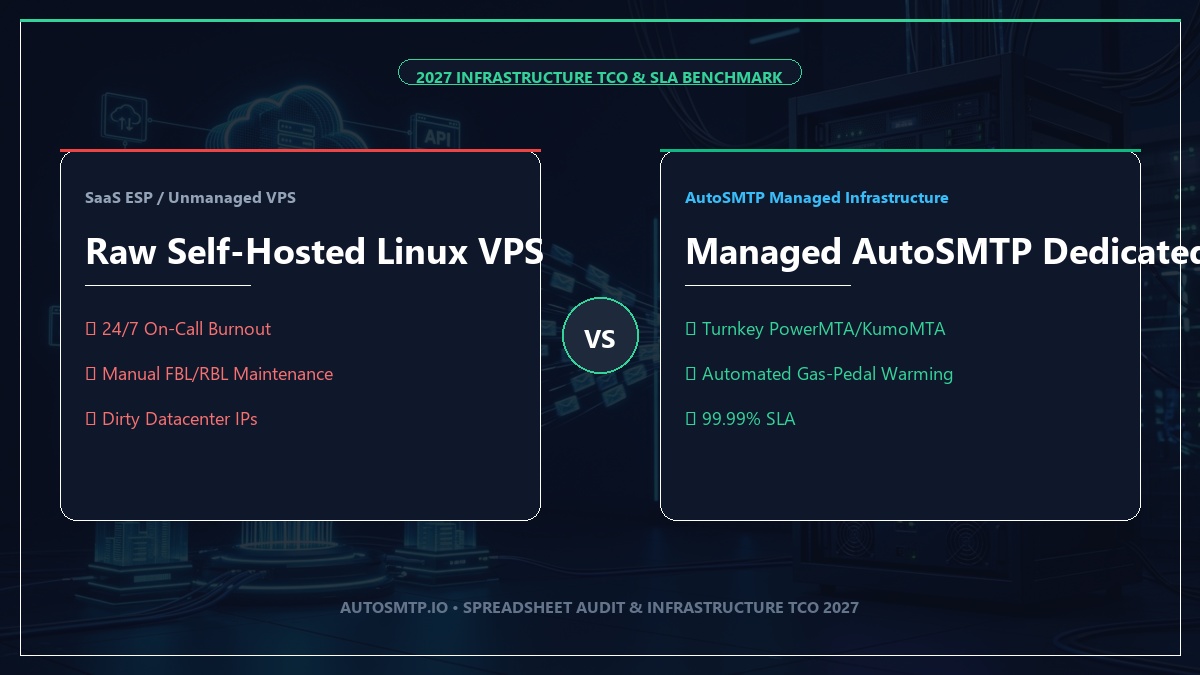
Managed Dedicated Email Infrastructure vs Raw Self-Hosted Linux: 2027 Engineering TCO & SLA Benchmark
Published by Fred Dawson • Senior Deliverability Systems Architect • 22 min read
When engineering teams decide to move away from expensive SaaS ESPs (SendGrid, Mailgun, HubSpot), they face a critical infrastructure fork: build and maintain raw self-hosted Linux mail servers (configuring Postfix, Dovecot, OpenDKIM, and Rspamd on generic cloud VPS instances) or partner with a Fully Managed Dedicated Provider like AutoSMTP. While raw self-hosting appears cheap on paper ($20–$50/mo for a budget VPS), it introduces hidden operational quicksands: 24/7 on-call engineer fatigue, dirty public cloud IP subnets with burned reputation, lack of carrier-grade connection backoff algorithms, constant DNSBL delisting firefighting, and zero deliverability SLAs. This benchmark provides an exhaustive architectural and financial audit comparing DIY Linux mail hosting against fully managed dedicated bare-metal infrastructure.
- 1. The DIY Self-Hosted Trap: The Real Engineering Cost of a $20 VPS
- 2. IP Subnet Provenance: Why AWS, Hetzner & DigitalOcean IPs Get Blacklisted
- 3. Spool Engine Capabilities: Postfix Basic Queues vs PowerMTA Clustered Backoffs
- 4. Ongoing Deliverability Maintenance: FBLs, Google Postmaster & 24/7 Monitoring
- 5. Managed AutoSMTP vs Raw Self-Hosted Linux Technical Matrix
- 6. The AutoSMTP Deliverability Defense Advantage
1. The DIY Self-Hosted Trap: The Real Engineering Cost of a $20 VPS
The temptation to self-host email is driven by simple arithmetic: a cloud VPS costs $20/month, whereas enterprise ESPs charge thousands. However, this calculation ignores engineering payroll:
- The DevOps Tax: Configuring and maintaining a production email stack (Postfix, OpenDKIM, DNSSEC, DMARC, Rspamd, ClamAV, Redis, Dovecot) requires approximately 10 to 20 hours of senior DevOps engineering time per month. At an average senior engineer salary of $75–$120/hour, self-hosting actually costs $1,200 to $2,400/month in lost developer bandwidth.
- The Opportunity Cost: When engineers spend weekends diagnosing Postfix queue locks, delisting IPs from Spamhaus, or troubleshooting TLS handshake failures, they are not shipping core product features.
2. IP Subnet Provenance: Why AWS, Hetzner & DigitalOcean IPs Get Blacklisted
The single greatest operational hurdle with DIY Linux hosting is public cloud IP reputation:
The Public Cloud IP Dirty Subnet Trap
Public cloud providers (DigitalOcean, Linode, AWS, Hetzner) recycle IP addresses constantly. Millions of botnets, crypto-miners, and throwaway spammers cycle through these IP ranges. When you provision a new VPS, there is an 85%+ probability that the assigned IP address is already blacklisted on Spamhaus SBL, Barracuda, or UCEPROTECT.
AutoSMTP assigns pristine, carrier-grade IPv4 subnets that have never been used for generic public cloud hosting. Every IP is pre-warmed, pre-aligned with Forward-Confirmed Reverse DNS (FCrDNS), and continuously audited against 34 global DNSBL registries.
3. Spool Engine Capabilities: Postfix Basic Queues vs PowerMTA Clustered Backoffs
Software architecture determines delivery throughput under stress:
Standard Postfix/Exim: Postfix is an exceptional mail daemon for general Unix environments, but lacks native high-volume queue intelligence. When Yahoo or Gmail returns a 421 deferral, Postfix applies global backoff formulas across the entire queue. Outbound delivery slows to a crawl.
AutoSMTP PowerMTA / KumoMTA Engines: AutoSMTP utilizes commercial-grade, multi-threaded MTA engines with granular, per-domain rate limiting, independent Virtual MTA IP binding, and sub-second in-band 550 bounce suppression. A single AutoSMTP node delivers over 1.5 million messages per hour with zero queue lockup.
4. Ongoing Deliverability Maintenance: FBLs, Google Postmaster & 24/7 Monitoring
Email infrastructure is not a “set-and-forget” technology. Keeping inbox placement above 99% requires daily vigilance:
# Raw Self-Hosted Linux: Manual, brittle, high engineering fatigue
1. Manually check logs for 421 / 550 deferrals: grep "status=deferred" /var/log/mail.log
2. Manually submit delisting tickets to Microsoft SNDS and Spamhaus
3. Manually configure and rotate 2048-bit DKIM keys every 90 days
4. Manually update Postfix transport maps when destination ISPs change connection caps

# AutoSMTP Fully Managed: 100% Automated Turnkey Deliverability
✓ Turnkey Google Postmaster API integration & spam ratio tracking (<0.1%)
✓ Automated Yahoo & Outlook Complaint Feedback Loop (CFL) ingest & suppression
✓ 24/7/365 Proactive DNSBL monitoring across 34 global registries
✓ Automated Gas-Pedal IP warming with algorithmic ISP backoff formulas
5. Managed AutoSMTP vs Raw Self-Hosted Linux Technical Matrix
| Strategic Pillar | Raw Self-Hosted Linux (DIY VPS) | Managed AutoSMTP Infrastructure | Engineering Impact |
|---|---|---|---|
| Setup & Deployment | 40+ hours manual configuration & debugging | Instant turnkey deployment in < 15 minutes | Saves weeks of senior DevOps engineering time |
| IP Reputation Quality | Dirty public cloud recycled IPs (High ban rate) | Pristine, pre-vetted dedicated /29 IPv4 subnets | Eliminates upfront Spamhaus and Microsoft blacklists |
| MTA Spool Engine | Basic Postfix/Exim (Crude global backoff) | PowerMTA & KumoMTA (Per-domain concurrency) | 10x higher burst throughput without queue starvation |
| Ongoing Maintenance | 10-20 hours/month engineering maintenance | 100% Managed by AutoSMTP deliverability team | Frees developers to focus on core product features |
| Deliverability SLA | Zero SLA (When it breaks, you fix it at 3 AM) | 99.99% Hardware & Deliverability Uptime SLA | Complete operational peace of mind |
Recovering 120 Hours of DevOps Time for Growing SaaS Platform
A fast-growing B2B analytics platform attempted to build its own self-hosted Postfix/OpenDKIM email stack on cloud VPS instances. Over six months, the engineering team spent over 120 hours dealing with IP blacklists, Google Postmaster deliverability drops, and queue lockups. The company migrated to AutoSMTP managed bare-metal infrastructure. With turnkey deliverability monitoring, dedicated /29 clean subnets, and 99.99% uptime, the firm recovered over $85,000 in developer payroll hours and achieved 99.8% inbox placement.
The AutoSMTP Deliverability Defense Advantage
Inbound and outbound filtering pipelines require robust underlying transport hardware. AutoSMTP provisions sovereign, dedicated bare-metal MTA infrastructure engineered for high-throughput filtering, synchronous 550 bounce suppression, and permanent reputation control.
Provisions fully licensed PowerMTA and KumoMTA clusters on enterprise bare-metal with dedicated IPv4 subnets and predictable flat pricing.
Monitors Google Postmaster spam ratios (<0.1%) and real-time ISP deferrals with algorithmic volume scaling across your entire IP pool.
RFC 5321 in-band 550 bounce suppression, automated Yahoo/Outlook Complaint Feedback Loops (CFL), and instant bad-IP eviction.
Pre-configured forward and reverse DNS (PTR) per IP, SPF CIDR alignment, 2048-bit DKIM rotation, and strict DMARC enforcement.
Upgrade Your Email Infrastructure with Dedicated Bare Metal
Eliminate filter lag, queue serialization bottlenecks, and noisy neighbor contamination. Deploy a turnkey AutoSMTP cluster today.
Deploy Turnkey MTA Cluster →