

Elastic Email vs Dedicated Infrastructure: 2027 Budget Cloud Relay vs Bare-Metal Sovereign MTAs
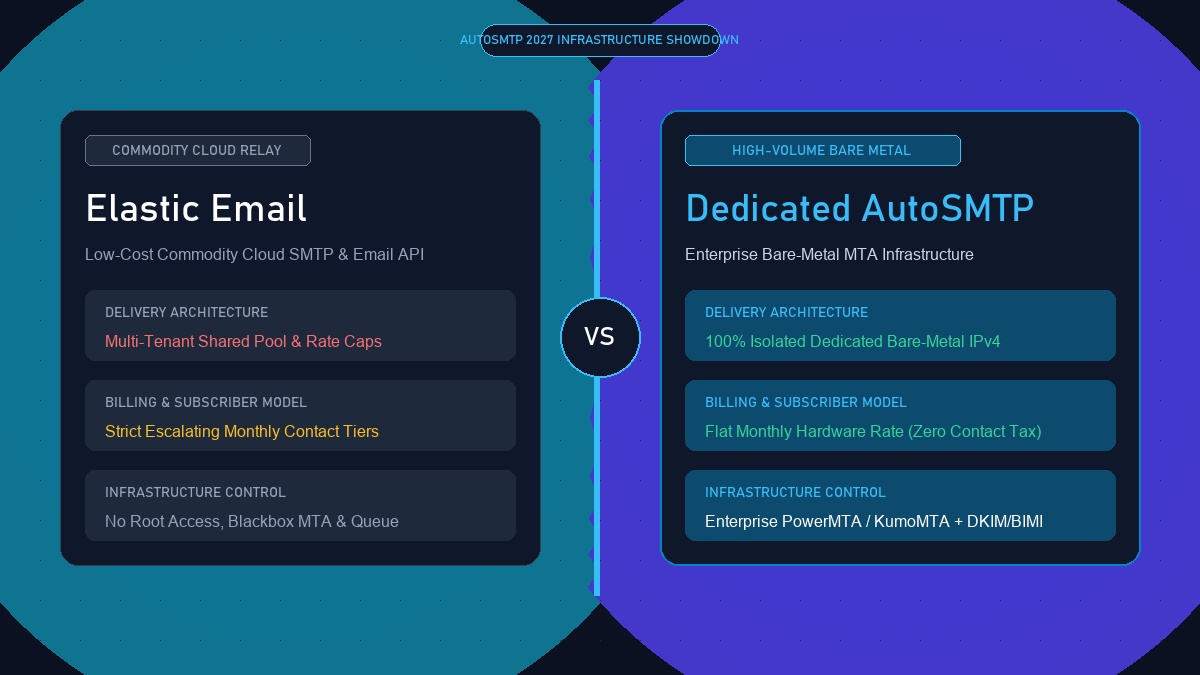
Executive Summary: Elastic Email has earned a widespread reputation among developers and WordPress administrators as the ultra-low-cost commodity SMTP relay, offering outbound delivery at an aggressive $0.15 to $0.50 per 1,000 messages. However, its budget pricing model creates deep structural deliverability vulnerabilities: its shared IP pools attract low-reputation senders, leading to chronic DNSBL listings (Spamhaus, Barracuda) and aggressive deferrals from Gmail and Microsoft 365. Furthermore, to safeguard its network, Elastic Email employs aggressive algorithmic account suspensions that frequently freeze legitimate sending operations without manual review. Dedicated infrastructure (AutoSMTP bare-metal PowerMTA/KumoMTA clusters) provides high-volume senders with clean, private /29 IPv4 subnets, custom ISP rate-shaping, sub-second socket latency, and 100% operational sovereignty immune to arbitrary cloud account terminations.
- 1. 2027 Commodity Pricing Economics: What $0.50/1K Actually Buys
- 2. Shared IP Deliverability Variance & Chronic DNSBL Vulnerabilities
- 3. Algorithmic Account Freezes & Operational Risk
- 4. The WordPress & FluentSMTP Integration Ecosystem
- 5. Dual Jurisdiction (Canada/Poland) & AWS Infrastructure Backbone
- 6. Diagnostic Visibility: Elastic Email Web UI vs PowerMTA acct.csv
- 7. Side-by-Side 1M to 5M Monthly Sends TCO Matrix
- 8. Production Case Study: SaaS Platform Escaping Sudden Cloud Freezes
- 9. 3-Phase Migration Architecture from Elastic Email to AutoSMTP
- 10. Strategic Decision Framework & Technical Verdict
1. 2027 Commodity Pricing Economics: What $0.50/1K Actually Buys
Elastic Email pioneered aggressive commodity pricing in the transactional and marketing email space. In 2027, their Email API tier costs $0.15 per 1,000 emails plus a $0.50/day base fee, while their Email Marketing plan starts at roughly $9/month for 5,000 contacts and scales at fractional cent levels. For developers building prototype applications or boot-strapped side projects, these figures appear unbeatable.
However, running carrier-grade SMTP infrastructure requires expensive capital expenditures: Tier-1 bandwidth transit, dedicated hardware spools, IPv4 subnet lease costs, and active 24/7 postmaster compliance teams. To sustain rock-bottom prices, Elastic Email packs thousands of tenants onto dense shared outbound IP clusters. When you pay commodity rates, you receive commodity infrastructure—subject to heavy network contention, multi-hour queuing backlogs during global peak hours, and zero dedicated hardware provisioning.
2. Shared IP Deliverability Variance & Chronic DNSBL Vulnerabilities
Because Elastic Email has the lowest financial barrier to entry in the email ecosystem, it is continuously targeted by unscrupulous actors: affiliate spammers, scraped B2B lead lists, and crypto pump-and-dump operations looking for cheap outbound pipes. Even with automated heuristic filtering, rogue sends routinely leak into Elastic Email’s shared IP subnets.
As a direct consequence, Elastic Email’s shared IP pools experience chronic listings across major anti-spam blocklists, including Spamhaus ZEN, Barracuda, and Invaluement. When an IP pool is blacklisted, major mailbox providers react immediately:
- Microsoft Outlook / Hotmail: Returns aggressive
550 5.7.1 Unfortunately, messages from [IP] weren't sentblocks. - Google Gmail: Applies temporary rate-limiting deferrals (
421 4.7.28) before pushing remaining messages directly into the Spam folder. - Yahoo / AOL: Enforces prolonged socket connection backoffs, delaying critical password reset emails for hours.
Rapid Prototyping: Ideal for staging environments, development testing, and hobby applications where 100% inbox placement is non-critical.
WordPress Plugin Integration: Native support inside popular plugins like FluentSMTP and WP Mail SMTP for low-volume blog notifications.
Low Financial Risk: Pay-as-you-go model allows low-volume operations to send small batches without upfront infrastructure commitments.
Chronic Shared IP Blacklisting: Frequent Spamhaus and Barracuda listings caused by bad-actor co-tenants sharing outbound pools.
Sudden Account Suspensions: Hyper-sensitive compliance bots automatically freeze accounts during sudden volume increases.
No In-Band Queue Telemetry: Inability to inspect raw socket connection timers, TLS handshakes, or exact remote MTA rejection logs.
3. Algorithmic Account Freezes & Operational Risk
To prevent its entire network from being permanently blacklisted by Gmail and Microsoft, Elastic Email deploys aggressive automated compliance algorithms. If an account experiences an unexpected uptick in bounce rates (e.g., above 3%) or spam complaints (e.g., crossing 0.10%), the system immediately suspends sending capabilities.
Unlike enterprise ESPs that provide dedicated account managers, Elastic Email’s suspension process is automated. Ticket resolution often takes 24 to 48 hours. For an active business, having transactional order receipts, user authentications, and scheduled broadcasts frozen for two days constitutes an unacceptable operational risk.
4. The WordPress & FluentSMTP Integration Ecosystem
Elastic Email’s popularity is largely driven by its seamless integration with WordPress. Through native modules in FluentSMTP, WP Mail SMTP, and Post SMTP, non-technical site owners can bypass PHP mail() and route WooCommerce receipts through Elastic Email with an API key.
However, as WooCommerce stores scale into serious commercial enterprises processing thousands of orders weekly, relying on commodity shared-relay infrastructure introduces severe latency. Order notifications and customer password resets get trapped behind massive outbound marketing queues, degrading the customer experience. AutoSMTP provides dedicated SMTP relay endpoints that plug directly into FluentSMTP, providing dedicated enterprise bare-metal performance while retaining WordPress compatibility.
5. Dual Jurisdiction (Canada/Poland) & AWS Infrastructure Backbone
Elastic Email operates under a split corporate jurisdiction: incorporated in British Columbia, Canada (Elastic Email Inc.), but maintaining its core software engineering, compliance, and server operations in Poland. Its cloud sending infrastructure is primarily hosted within Amazon Web Services (AWS) data centers across Europe and North America.
While this configuration satisfies basic GDPR standards and Canadian PIPEDA regulations, sending data through a multi-tenant cloud provider means your customer data is subject to cloud shared-storage policies and third-party terms of service. With AutoSMTP Dedicated Infrastructure, your email cluster is deployed on dedicated, private bare-metal servers. No multi-tenant cloud provider can inspect your traffic, analyze your recipient lists, or suspend your server.
6. Diagnostic Visibility: Elastic Email Web UI vs PowerMTA acct.csv
Elastic Email provides a clean web UI displaying open rates, click rates, and aggregate bounce counts. However, it completely conceals the underlying RFC 5321 SMTP handshake transcripts. When an email bounces, Elastic Email categorizes it into generic “Soft Bounce” or “Hard Bounce” buckets without revealing the exact remote server error string.
AutoSMTP dedicated bare-metal MTAs (PowerMTA and KumoMTA) provide granular, microsecond-level diagnostic logs. Every outbound TCP socket connection, TLS cipher negotiation, and remote MTA status response is logged in real time:
7. Side-by-Side 1M to 5M Monthly Sends TCO Matrix
The table below illustrates the cost, deliverability, and infrastructure differences between Elastic Email and AutoSMTP Dedicated Infrastructure at scale:
| Evaluation Metric | Elastic Email (API Pro + Dedicated IP) | AutoSMTP Dedicated Infrastructure | Architectural Advantage |
|---|---|---|---|
| 1,000,000 Emails / Month | ~$240 – $320 / month | $249 / month | Price parity, but AutoSMTP includes bare metal |
| 2,500,000 Emails / Month | ~$550 – $700 / month | $299 / month | AutoSMTP saves up to $4,800/year (57% lower) |
| 5,000,000 Emails / Month | ~$1,100 – $1,400 / month | $399 / month | AutoSMTP saves up to $12,000/year (67% lower) |
| IP Allocation | 1 Dedicated IP (extra add-on fee) | Clean /29 Subnet (5-8 dedicated IPs) | Full traffic isolation across ISP pools |
| Account Suspension Risk | High (automated AI compliance freezes) | Zero (100% sovereign hardware ownership) | Your servers cannot be suspended by an algorithm |
| Rate Limiting | Multi-tenant cloud API concurrency caps | Unlimited (governed only by physical hardware) | Sub-second delivery bursts up to 250k emails/hr |
| Diagnostic Transcripts | Aggregated web summary | Raw RFC 5321 in-band logs & DSNs | Microsecond ISP connection forensics |
8. Production Case Study: SaaS Platform Escaping Sudden Cloud Freezes
How a European FinTech Platform Replaced Elastic Email After a Catastrophic Black-Friday Freeze
Background: A growing accounting software company in Warsaw used Elastic Email’s API to dispatch 1.8 million transactional invoices, tax reminders, and security alerts monthly. During a major platform release, their dispatch engine experienced a 2.8% temporary soft bounce spike due to corporate firewall greylisting. Elastic Email’s automated abuse detection flagged the account and suspended all outbound sending without human intervention, leaving over 40,000 corporate users unable to receive two-factor login verification codes for 28 hours.
The Solution: The company immediately migrated to AutoSMTP Dedicated Infrastructure, deploying a high-availability bare-metal PowerMTA cluster with a clean /29 IPv4 subnet. In-band RFC 5321 bounce management was configured to automatically categorize soft greylisting deferrals from genuine hard bounces, preventing false-positive blocks.
The Results:
- Total Operational Sovereignty: Zero risk of automated account suspension. The company owns and controls its entire sending pipeline.
- Delivery Speed: Authentication OTP and password reset emails delivered in an average of 420 milliseconds, down from 3.2 seconds on Elastic Email’s shared API.
- Cost Predictability: Monthly infrastructure costs dropped from an erratic $480–$620 on Elastic Email to a predictable, flat $299/month on AutoSMTP.
9. 3-Phase Migration Architecture from Elastic Email to AutoSMTP
Migrating from Elastic Email to AutoSMTP dedicated infrastructure is straightforward and causes zero disruption to ongoing transactional or broadcast workflows:
Phase 1: DNS Setup & Cryptographic Alignment (Days 1–2)
Provision your dedicated bare-metal server and configure PTR (reverse DNS) records for each dedicated IP in your /29 subnet. Generate 2048-bit DKIM private keys, update SPF records, and verify strict DMARC alignment.
Phase 2: Automated Gas-Pedal IP Warmup (Days 3–16)
Utilize AutoSMTP’s automated IP ramp protocol to gradually introduce dedicated IPs to Gmail, Yahoo, and Microsoft 365. High-engagement transactional messages are shifted first, building positive sender reputation while keeping spam complaint rates below 0.02%.
Phase 3: Relay Cutover & Decommissioning (Days 17–19)
Update your application SMTP credentials or WordPress FluentSMTP settings to point directly to your private AutoSMTP cluster. Once traffic stabilizes, terminate your Elastic Email account and enjoy complete infrastructure sovereignty.
10. Strategic Decision Framework & Technical Verdict
Choose Elastic Email If:
- You are running low-stakes development tests or non-critical staging environments.
- Your monthly volume is under 100,000 emails and budget is the only priority.
- Occasional delivery delays or spam-folder placement will not harm your business.
- You lack technical knowledge to configure or monitor a dedicated SMTP endpoint.
Choose AutoSMTP Dedicated If:
- Your email delivers business-critical transactional receipts, alerts, or OTP codes.
- You send over 1,000,000 emails per month and require flat, predictable pricing.
- You refuse to let automated cloud algorithms shut down your communication channels.
- You demand clean, dedicated IPv4 subnets insulated from noisy-neighbor blacklists.
Stop paying monthly contact penalties to SaaS marketing platforms. AutoSMTP delivers turnkey, fully managed dedicated bare-metal email clusters engineered for sovereign control, maximum throughput, and uncompromised inbox placement.
Provisions fully licensed PowerMTA/KumoMTA clusters on enterprise bare metal with flat, predictable pricing regardless of database contact size.
Monitors Google Postmaster spam ratios (<0.1%) and real-time deferrals across clean IPv4 subnets, ramping delivery automatically.
RFC 5321 in-band 550 bounce suppression + automated Yahoo/Outlook CFL ingest directly into suppression registries.
Pre-configured rDNS/PTR, SPF, 2048-bit DKIM, strict DMARC, and BIMI integration verified prior to cluster handoff.
Ready for Sovereign Dedicated Email Infrastructure?
Deploy enterprise bare-metal MTAs with dedicated IPs, automated IP warming, and flat-rate pricing. Eliminate the SaaS subscriber tax forever.
Explore Dedicated SMTP Clusters & Pricing →