

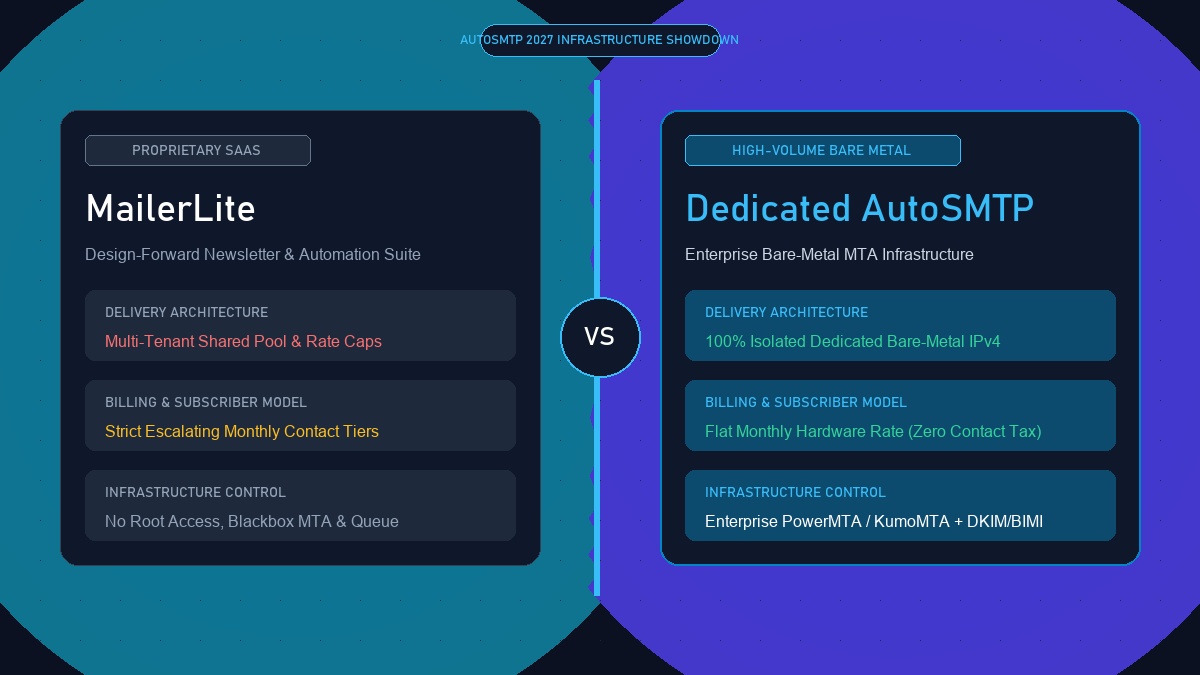
MailerLite vs Dedicated Infrastructure: 2027 Creator SaaS vs Sovereign High-Volume MTAs
Executive Summary: MailerLite has long stood as the darling of independent creators, micro-SaaS founders, and boutique newsletter publishers due to its clean minimalist interface, intuitive visual automation canvas, and historically generous freemium model. However, following its acquisition by Polish communications group Vercom in 2022 and aggressive 2025/2026 free-tier halving, scaling senders hit a punishing “subscriber tax” coupled with shared-pool delivery bottlenecks. When a sender crosses 50,000 to 100,000 subscribers, MailerLite’s contact-based pricing escalates dramatically to $350–$700+/month, while their dedicated IP remains strictly gated behind a $50/mo add-on with severe pre-approval hurdles. Dedicated infrastructure (AutoSMTP bare-metal PowerMTA/KumoMTA paired with MailWizz or self-hosted frontends) decouples contact database size from infrastructure costs, offering flat monthly rates, dedicated IPv4 subnets, raw RFC 5321 in-band bounce diagnostics, and total exemption from third-party account terminations.
- 1. 2027 Pricing Trajectory: The Free-Tier Halving & Subscriber Tax
- 2. European Jurisdiction, Vercom Acquisition & Data Privacy
- 3. MailerLite AI Assistant & Visual Automation Capabilities
- 4. Deliverability Architecture: Shared Pools vs Dedicated Subnets
- 5. Diagnostic Visibility: MailerLite Reporting vs PowerMTA acct.csv
- 6. API Throughput & Automation Integration Architecture
- 7. Side-by-Side TCO Matrix: 50K, 100K, and 250K Subscribers
- 8. Production Case Study: Online Academy Escaping Contact Penalties
- 9. 3-Phase Migration Architecture from MailerLite to AutoSMTP
- 10. Strategic Decision Framework & Long-Term Evaluation
1. 2027 Pricing Trajectory: The Free-Tier Halving & Subscriber Tax
For nearly a decade, MailerLite established its market presence as the most accessible newsletter platform for solopreneurs and small operations. Historically offering 1,000 subscribers and 12,000 monthly sends at zero cost, it represented an easy entry point. However, following market consolidation, MailerLite restructured its pricing in late 2025: the free plan was sharply curtailed to 500 subscribers and 6,000 emails per month, while paid tiers saw accelerated step-ups.
The core structural challenge of MailerLite—shared with SaaS platforms like Mailchimp and ConvertKit—is the subscriber tax. You are billed based on the number of records residing in your database, regardless of how frequently you email them. A list of 100,000 contacts emailed twice a month costs between $540 and $720 per month on MailerLite’s Advanced plan. If you introduce segmented lead scoring or store historical customers for transactional lifecycle alerts, your monthly bill spikes without any corresponding increase in compute or bandwidth overhead.
2. European Jurisdiction, Vercom Acquisition & Data Privacy
Founded in Vilnius, Lithuania, MailerLite built a substantial competitive moat around European privacy compliance. In 2022, MailerLite was acquired by Vercom S.A., a publicly traded Polish communications company (WSE: VRC) that also operates Redlink and FreshMail. This corporate foundation gives MailerLite strong European data sovereignty credentials:
- GDPR & EU Data Residency: Core platform data centers are hosted within the European Union (predominantly AWS Frankfurt, Germany), with formal Data Processing Agreements (DPAs) and robust EU-US Data Privacy Framework adherence.
- Vercom Synergies: Access to regional European carrier relationships and localized customer support teams across Poland and the Baltic states.
- SaaS Compliance Overhead: However, as a regulated European commercial entity, MailerLite enforces stringent anti-abuse filters. Any list imported from external marketing funnels, trade shows, or B2B directory databases triggers automated compliance freezes requiring extensive opt-in documentation before sending can resume.
3. MailerLite AI Assistant & Visual Automation Capabilities
Where MailerLite excels is user experience. Its minimalist interface, visual drag-and-drop workflow canvas, and built-in website/landing page builder allow non-technical marketing teams to execute multi-branch drip campaigns quickly.
Visual Workflow Builder: Multi-trigger automation journeys based on clicks, form submissions, and custom webhook events with an intuitive canvas.
MailerLite AI Assistant: Native generative AI tools for subject line ideation, newsletter copy rewriting, and dynamic product recommendations.
Landing Pages & Digital Products: Integrated Stripe payments, paid newsletter subscriptions, and responsive landing pages hosted natively on custom domains.
Strict Sending Speed Throttling: Outbound throughput is governed by multi-tenant platform queues, with large broadcasts taking hours to dispatch.
Shared IP Co-Tenancy: Lower tiers share outbound IP pools with thousands of unrelated accounts, exposing sender reputation to neighbor spam spikes.
Gated Dedicated IP Add-On: Dedicated IPs cost an extra $50/month and require manual compliance pre-approval plus steady weekly volume.
4. Deliverability Architecture: Shared Pools vs Dedicated Subnets
On MailerLite’s standard Growing Business and Advanced plans, emails are routed through large shared outbound IP pools. While MailerLite vigorously polices bounce rates and spam complaints to maintain pool hygiene, shared-pool delivery inherently suffers from noisy-neighbor contamination. If another account in your IP pool launches an unverified cold batch that trips Gmail’s 0.10% spam threshold, every domain sharing that outbound interface experiences temporary throttling and inbox deferrals.
With AutoSMTP Dedicated Infrastructure, your delivery engine runs on dedicated bare-metal servers with pristine IPv4 subnets (/29 or /28 allocations). You own 100% of the domain and IP reputation. Outbound traffic is governed by custom VirtualMTAs configured with granular ISP rate-limiting rules:
5. Diagnostic Visibility: MailerLite Reporting vs PowerMTA acct.csv
When an email campaign fails on MailerLite, the web dashboard provides high-level aggregation: “Soft Bounce: 2.1%” or “Hard Bounce: 0.4%”. However, MailerLite does not expose the raw RFC 5321 SMTP transcript or server diagnostic code. You cannot see whether Gmail rejected the message due to missing PTR records, an unaligned DKIM signature, rate-limit backoff (421 4.7.28), or Spamhaus DBL listing.
In contrast, AutoSMTP provides complete diagnostic transparency via native MTA accounting logs (PowerMTA acct.csv and KumoMTA JSON event streams). Every single message receipt, deferral, and in-band refusal is logged with full socket telemetry:
6. API Throughput & Automation Integration Architecture
MailerLite provides a standard REST API (v2) with a strict rate limit of 120 requests per minute. For transactional sending, high-frequency user onboarding, or bulk verification syncing, this threshold forms an artificial ceiling. When your application triggers hundreds of simultaneous transactional confirmations, requests queue up or return HTTP 429 Too Many Requests.
With dedicated infrastructure, outbound API ingestion runs over high-speed local Unix sockets or private REST endpoints (such as KumoMTA’s native HTTP injection listener or RabbitMQ message brokers), sustaining throughput of 50,000 to 250,000+ messages per hour with zero artificial rate limits.
7. Side-by-Side TCO Matrix: 50K, 100K, and 250K Subscribers
The economic divergence between MailerLite and AutoSMTP Dedicated Infrastructure becomes undeniable once your list exceeds 50,000 contacts. Below is an annual total cost of ownership (TCO) comparison based on 2027 pricing:
| Evaluation Metric | MailerLite (Advanced Plan) | AutoSMTP Dedicated Infrastructure | Architectural Advantage |
|---|---|---|---|
| 50,000 Subscribers | $300 – $360 / mo ($3,600/yr) | $249 / mo ($2,988/yr) | AutoSMTP includes private server + dedicated IP |
| 100,000 Subscribers | $540 – $720 / mo ($6,480/yr) | $299 / mo ($3,588/yr) | AutoSMTP saves $2,892/year (45% reduction) |
| 250,000 Subscribers | $1,250 – $1,600 / mo ($15,000/yr) | $399 / mo ($4,788/yr) | AutoSMTP saves $10,212/year (68% reduction) |
| Dedicated IP Cost | +$50 / mo (strict pre-vetting required) | Included natively (clean /29 subnet) | Full reputation insulation with zero add-on fees |
| Monthly Email Limit | 12x subscriber count (soft cap) | Unlimited outbound capacity | Send daily newsletters without volume penalties |
| Data Privacy & Lock-In | SaaS cloud tenancy (Vercom Poland) | 100% Sovereign bare metal | Zero risk of arbitrary account suspension |
| Diagnostic Visibility | Aggregated bounce percentages | Raw RFC 5321 SMTP transcripts | Real-time ISP queue & TLS connection forensics |
8. Production Case Study: Online Academy Escaping Contact Penalties
How an E-Learning Academy Slashed Software Costs by 61% While Improving Gmail Inbox Rates
Background: A European digital skills academy operated a newsletter and course platform with 115,000 registered students and prospects on MailerLite’s Advanced plan, paying $740/month (including a $50/mo dedicated IP add-on). Because online course students frequently complete courses and become passive readers, the academy accumulated over 35,000 “cold” subscribers who opened emails infrequently. Pruning them meant losing the ability to retarget them during seasonal course launches, yet keeping them triggered expensive tier upgrades.
The Solution: In November 2026, the academy migrated its sending engine to AutoSMTP Dedicated Infrastructure, pairing a high-performance bare-metal PowerMTA node with a self-hosted MailWizz front-end. The migration followed AutoSMTP’s 21-day automated gas-pedal warming protocol across two dedicated IPv4 addresses, gradually ramping from 2,000 emails/day to 80,000 emails/day while keeping Gmail Postmaster spam complaint rates under 0.04%.
Results:
- Cost Reduction: Monthly email expenditure dropped from $740/mo to a flat $299/mo, delivering annual recurring savings of $5,292.
- Zero Pruning Anxiety: The academy retained all 115,000 contacts in its self-hosted database, allowing low-frequency quarterly reactivation campaigns without incurring tier upgrades.
- Inbox Placement: With dedicated IP reputation unpolluted by shared-pool neighbors, overall inbox placement increased from 84.2% to 96.8% across Microsoft 365, Gmail, and ProtonMail.
9. 3-Phase Migration Architecture from MailerLite to AutoSMTP
Migrating from MailerLite to AutoSMTP dedicated infrastructure requires zero downtime and preserves your historical subscriber engagement state:
Phase 1: Subscriber Sanitization & Segmented Export (Days 1–3)
Export your active subscribers, unsubscribes, and bounce lists from MailerLite via CSV or REST API. Run all contacts through AutoSMTP’s integrated email verification engine to remove obsolete addresses, syntax errors, and spam traps accumulated over time.
Phase 2: DNS Authentication & Gas-Pedal IP Warming (Days 4–18)
Configure matching 2048-bit DKIM keys, SPF records with dedicated IPv4 inclusion, strict DMARC (p=quarantine or p=reject), and verified BIMI records. Route 10% of high-engagement newsletter traffic through AutoSMTP’s dedicated MTA, utilizing our automated gas-pedal algorithm that scales daily volume based on real-time Google Postmaster reputation feedback.
Phase 3: Webhook Alignment & Full Traffic Cutover (Days 19–21)
Point opt-in forms, landing page webhooks, and transactional API calls to your new sovereign sending stack. Decommission paid MailerLite tiers or downgrade to the free tier for secondary testing, permanently locking in flat-rate dedicated infrastructure economics.
10. Strategic Decision Framework & Long-Term Evaluation
Choose MailerLite If:
- Your total subscriber count is under 15,000 contacts and sends are infrequent.
- You lack technical resources and require an all-in-one visual landing page and form builder.
- You rely heavily on native drag-and-drop newsletter templates and built-in AI copywriting prompts.
- You are comfortable with shared IP pools and do not require in-band SMTP diagnostic logs.
Choose AutoSMTP Dedicated If:
- Your list exceeds 50,000 subscribers and you refuse to pay escalating “contact taxes.”
- You need sovereign dedicated IPv4 subnets insulated from noisy-neighbor spam penalties.
- You require raw RFC 5321 diagnostic visibility to troubleshoot ISP deferrals in real time.
- You demand 100% ownership of your email stack with zero risk of sudden platform deplatforming.
Stop paying monthly contact penalties to SaaS marketing platforms. AutoSMTP delivers turnkey, fully managed dedicated bare-metal email clusters engineered for sovereign control, maximum throughput, and uncompromised inbox placement.
Provisions fully licensed PowerMTA/KumoMTA clusters on enterprise bare metal with flat, predictable pricing regardless of database contact size.
Monitors Google Postmaster spam ratios (<0.1%) and real-time deferrals across clean IPv4 subnets, ramping delivery automatically.
RFC 5321 in-band 550 bounce suppression + automated Yahoo/Outlook CFL ingest directly into suppression registries.
Pre-configured rDNS/PTR, SPF, 2048-bit DKIM, strict DMARC, and BIMI integration verified prior to cluster handoff.
Ready for Sovereign Dedicated Email Infrastructure?
Deploy enterprise bare-metal MTAs with dedicated IPs, automated IP warming, and flat-rate pricing. Eliminate the SaaS subscriber tax forever.
Explore Dedicated SMTP Clusters & Pricing →