

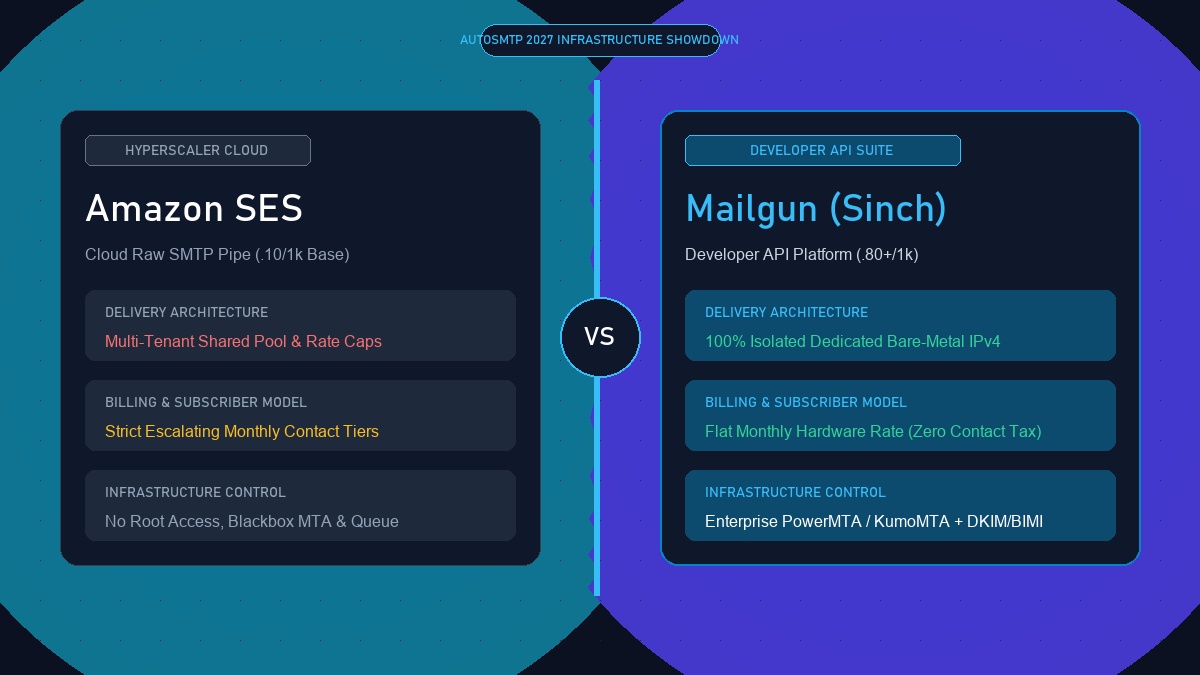
Amazon SES vs Mailgun: 2027 API Showdown After the Flex Plan Restructuring
The developer rivalry between Amazon Simple Email Service (SES) and Mailgun (by Sinch) defines modern transactional email routing. Historically, Mailgun offered a generous pay-as-you-go tier, but following Sinch’s aggressive post-acquisition pricing restructurings (doubling Flex overage charges to $1.20+/1k and forcing monthly commitments), engineering teams face a stark economic reality. Amazon SES remains the industry’s lowest-cost commodity raw pipe ($0.10 per 1,000 emails), but requires developers to build their own reputation monitors, bounce webhooks, and log analytics. Dedicated bare-metal infrastructure provides the ultimate alternative: flat hardware rates, complete MTA control, and immunity to hyperscaler cloud bans.
- 1. What Changed: The Sinch Mailgun Restructuring
- 2. Side by Side: Commodity Pipe vs API Platform
- 3. The Real Total Cost of Amazon SES in Production
- 4. Mailgun 2027 Plan Economics & Agency Markup
- 5. Deliverability Governance & The AWS Probation Trap
- 6. Full Technical Comparison Matrix
- 7. High-Volume Agency Migration Case Study
- 8. Strategic Decision Framework
1. What Changed: The Sinch Mailgun Restructuring
For nearly a decade, Mailgun was the go-to recommendation for startup developers. Its “Flex Plan” allowed teams to send their first 10,000 emails free every month, followed by a flat $0.80 per thousand emails with zero monthly subscription fees.
Following Sinch’s acquisition of Mailgun, that business model was completely dismantled:
- The End of True Pay-As-You-Go: The free tier was stripped down to a temporary 30-day trial, forcing all production users into monthly recurring tiers ($35/mo for Foundation 50k, $90/mo for Foundation 100k).
- Overage Penalties: Exceeding your purchased plan threshold triggers overage charges as high as $1.20 to $1.60 per thousand emails.
- GoHighLevel & Agency Margin Collapse: Digital agencies reselling sub-accounts saw wholesale email routing costs increase by 300% to 500% virtually overnight.
In contrast, Amazon SES has held its headline pricing steady at $0.10 per 1,000 emails ($0.0001 per message). However, utilizing SES in production requires navigating significant architectural complexity.
2. Side by Side: Commodity Pipe vs API Platform
- Turnkey Event Webhooks: Immediate HMAC-signed webhooks for opens, clicks, unsubscribes, and temporary deferrals.
- Inbound Route Parsing: Native MIME parsing engine extracts recipient, sender, attachments, and stripped plaintext.
- Email Validation API: Built-in syntax, MX record, and mailbox ping validation endpoints.
- Searchable Event Logs: 3 to 30 days of message log retention searchable by message-ID directly in the web UI.
- No Native Searchable Log UI: SES does not store email content or logs; you must configure CloudWatch, Kinesis Firehose, and S3.
- SNS Topic Overhead: Bounces and complaints require manual setup of AWS SNS topics and custom HTTP listener endpoints.
- Strict Sandbox Isolation: New AWS accounts are locked in a sandbox limited to 200 emails/day until manual support approval.
- Zero Inbound GUI: Processing inbound email requires S3 buckets and AWS Lambda execution scripts.
3. The Real Total Cost of Amazon SES in Production
While Amazon SES quotes $0.10/1k emails, enterprise production deployments inevitably incur additional AWS line-item charges:
1. SES Base Sending Bandwidth (1M emails @ $0.10/1k)    : $100.00
2. Dedicated IPv4 Standard Address (1 IP @ $24.95/mo)   : $24.95
3. Amazon SNS Topic Delivery (Bounces & Complaints)     : $0.60
4. CloudWatch Metric Alarms & Custom Dashboard          : $12.00
5. Kinesis Data Firehose Streaming (Raw log ingest)     : $16.50
6. Amazon S3 Storage & Athena Log Queries               : $8.40
------------------------------------------------------------------
Total Monthly AWS Infrastructure Spend                  : $162.45
Engineering Maintenance Overhead (DevOps configuration) : ~15 hrs setup
4. Mailgun 2027 Plan Economics & Agency Markup
When comparing total costs at scale, Mailgun’s tiered plans become dramatically more expensive than Amazon SES or dedicated bare-metal infrastructure:
| Monthly Sends | Mailgun Foundation / Scale | Amazon SES (Base + Dedicated IP) | Dedicated AutoSMTP Bare Metal | Annual Savings vs Mailgun |
|---|---|---|---|---|
| 100,000 sends | $90 / mo | $35 / mo | $49 / mo | Save $492 / yr |
| 250,000 sends | $215 / mo | $50 / mo | $99 / mo | Save $1,392 / yr |
| 500,000 sends | $425 / mo | $75 / mo | $129 / mo | Save $3,552 / yr |
| 1,000,000 sends | $750 / mo | $125 / mo | $189 / mo | Save $6,732 / yr (75%) |
| 5,000,000 sends | $2,850+ / mo | $525 / mo | $349 / mo | Save $30,012 / yr (88%) |
5. Deliverability Governance & The AWS Probation Trap
The most dangerous aspect of deploying Amazon SES at scale is its unforgiving automated probation mechanism:
- The 0.10% Complaint Cliff: AWS automatically places an SES account on probation if spam complaints exceed 0.1% (1 complaint per 1,000 recipients).
- The 0.05% Shutdown Trigger: If complaints reach 0.5%, your entire AWS account’s sending privileges are suspended immediately. Reinstatement requires filing detailed remediation plans and waiting days for AWS Trust & Safety triage.
- The 5.0% Bounce Rule: Hard bounces exceeding 5% trigger immediate automated warnings, and 10% hard bounces result in instantaneous shutdown.
Mailgun provides slightly more leeway through internal suppression lists, but still suspends accounts that generate excessive Spamhaus listings.
6. Full Technical Comparison Matrix
| Evaluation Parameter | Amazon SES | Mailgun (Sinch) | Dedicated AutoSMTP Infrastructure |
|---|---|---|---|
| Core Value Proposition | Raw, low-cost commodity sending pipe | Turnkey developer email API with rich logs | Flat-rate bare metal MTA with 100% private IP pools |
| Cost per 1,000 Emails | $0.10 (Fixed commodity) | $0.75 – $1.20+ (Tiered SaaS) | $0.03 – $0.07 effective hardware rate |
| Dedicated IP Pricing | $24.95 / mo per IPv4 | Included only on $90+/mo tiers | Multiple clean dedicated IPs included standard |
| Automated Bounce Ingestion | Requires custom SNS + SQS/Lambda setup | Native HTTP webhooks out of the box | RFC 5321 in-band 550 socket bounce suppression |
| Searchable Log Retention | Requires external CloudWatch / S3 pipeline | 3 to 30 days in web interface | Permanent local MySQL / MariaDB event history |
| Throughput & Concurrency | Governed by AWS account sending quota | Tier-dependent queue limits | Up to 500,000+ messages/hour per bare-metal node |
| Account Termination Risk | High; automated probation at 0.1% spam complaints | Moderate; automated compliance account freezes | Zero risk; private bare-metal infrastructure cannot be banned |
7. High-Volume Agency Migration Case Study
GoHighLevel Agency Eliminates $18,000 in Annual Mailgun Overage Surcharges
A marketing automation agency operating over 65 sub-accounts for local service businesses was dispatching approximately 2.2 million marketing and appointment confirmation emails per month via Mailgun. Following Mailgun’s price increases, monthly invoices skyrocketed from $450/mo to over $1,850 per month due to unexpected overage penalties.
The agency migrated their sending backend to an AutoSMTP Dedicated PowerMTA Bare-Metal Node paired with a multi-tenant MailWizz frontend:
- Cost Optimization: Monthly email expenditure dropped from $1,850/mo to a flat $249/mo server allocation—an annual savings of $19,212 (86% reduction).
- Sub-Account Isolation: Each agency client was assigned their own Virtual MTA with dedicated sending IPs, preventing client spam spikes from degrading the agency’s primary reputation.
- Zero Overage Anxiety: Dispatching 3 million emails in high-volume promotional months costs exactly the same as dispatching 1 million emails.
8. Strategic Decision Framework
You are already running your application architecture inside AWS (EC2, ECS, Lambda), your engineering team has the DevOps bandwidth to configure CloudWatch, SNS, and S3 logging pipelines, and you send clean transactional receipts with virtually zero spam complaints (<0.05%).
You are an engineering team that requires instant REST API webhooks, inbound email parsing, and a pre-built web dashboard for debugging, your monthly send volume is under 100,000 emails, and your budget accommodates paying an 8x premium over raw infrastructure.
You send more than 200,000 emails per month, operate an agency managing multiple client brands, require high-speed bare-metal MTA throughput without API rate limits, or refuse to risk business interruption from automated cloud account suspensions. AutoSMTP provides the reliability of dedicated bare metal with zero administrative burden.
Deploy Dedicated Bare-Metal MTA Power
Stop overpaying for cloud API markups and escape AWS probation anxiety. AutoSMTP provisions dedicated NVMe bare-metal clusters powered by enterprise PowerMTA or KumoMTA, managed 24/7 by deliverability specialists.
Dedicated enterprise MTA engines on bare-metal NVMe servers with 100% private IPv4 subnets and zero shared resource contention.
Intelligent warmup pacing monitoring Google Postmaster spam ratios (<0.1%) and real-time deferrals across clean IPv4 subnets.
RFC 5321 in-band 550 bounce suppression and automated Yahoo/Outlook Complaint Feedback Loop processing directly into your sending queues.
Pre-configured rDNS/PTR, SPF, 2048-bit DKIM, strict DMARC, and BIMI SVG certificates managed 24/7 by deliverability specialists.
Stop paying cloud API markups. Scale your email sending with dedicated bare-metal MTA power today.