

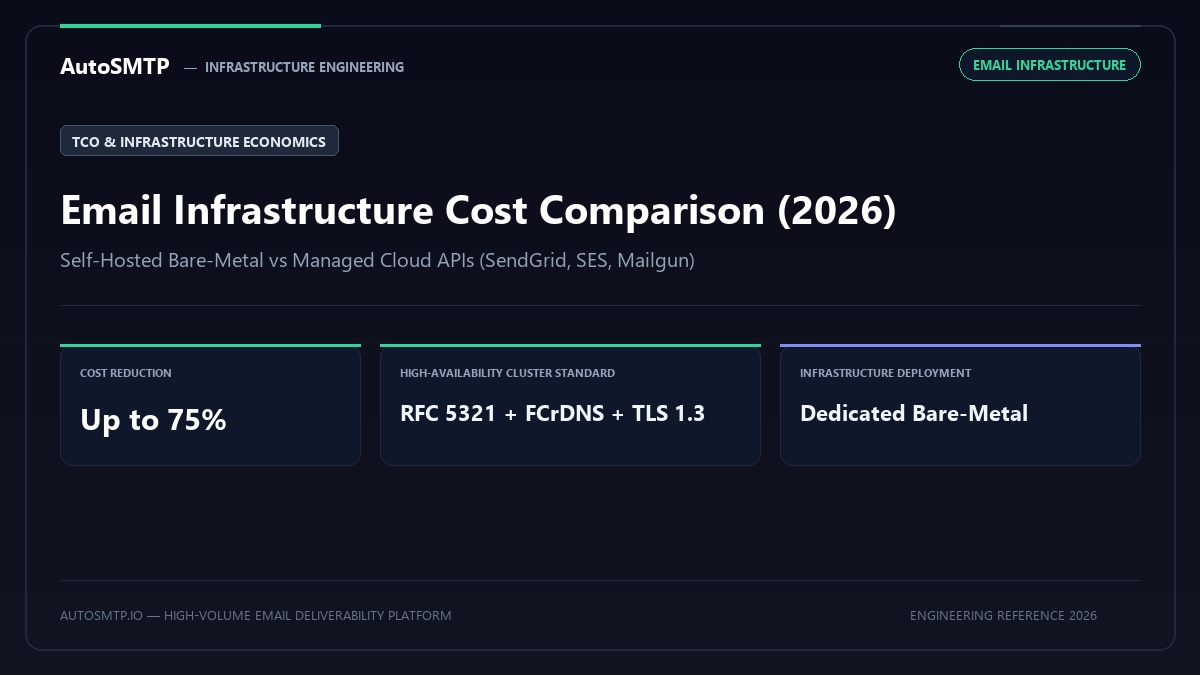
Email Infrastructure Cost Comparison 2026: Self-Hosted MTA vs ESP Pricing at Scale
The build-vs-buy decision for email infrastructure comes down to a cost-benefit analysis that shifts dramatically with volume. At 100,000 emails/month, a managed ESP is almost always cheaper when engineering time is included. At 10 million/month, the economics often favour self-hosted infrastructure. Understanding where the break-even lies for your specific volume, sending pattern, and team capabilities determines which approach is financially sound. Monthly Email Infrastructure Cost — ESP vs Self-Hosted MTA by Volume (USD)
- → Cost Structure: Self-Hosted vs Managed
- → Self-Hosted MTA Cost Breakdown
- → Managed ESP Pricing at Volume
- → Break-Even Analysis: When Self-Hosted Becomes Cheaper
- → Hidden Costs in Both Models
- → Hybrid Architecture: The Practical Middle Ground
- → Hidden Costs That the Invoice Never Shows
- → Making the Decision: A Volume-Based Framework
Cost Structure: Self-Hosted vs Managed
The fundamental difference in cost structure:
Self-hosted MTA (PowerMTA, KumoMTA, Postfix) has predominantly fixed costs that don’t scale linearly with volume — server hardware or VPS, IP addresses, software licensing if applicable, and engineering time. The marginal cost of sending one additional email approaches zero once infrastructure is provisioned.
Managed ESP (SendGrid, AWS SES, Mailgun, Postmark) has predominantly variable costs that scale directly with volume. Cost per email decreases with volume through tier pricing, but the marginal cost never reaches zero. Engineering time is lower — the ESP handles infrastructure, deliverability relationships, and compliance — but you pay for that labour in the per-email fee.
Self-Hosted MTA Cost Breakdown
One-time and setup costs
- Server hardware or dedicated VPS: $200–$800/month depending on specs (see capacity table in PowerMTA guide)
- IP addresses: $1–$3/IP/month from most data centres; $2–$10/IP from cloud providers
- PowerMTA license: $8,000–$15,000/year for typical production license. KumoMTA and Postfix are free.
- Initial setup engineering: 40–120 hours of senior engineer time (MTA configuration, DKIM, SPF, monitoring, IP warming)
Ongoing monthly costs
| Volume tier | Server | IPs (5) | MTA license (pro-rated) | Engineering (hrs/mo) | Total/month |
|---|---|---|---|---|---|
| 1M emails/month | $300 | $15 | $700 (PowerMTA) / $0 (Postfix) | 5hrs @ $150 = $750 | ~$1,765 |
| 10M emails/month | $600 | $30 | $1,200 | 10hrs = $1,500 | ~$3,330 |
| 100M emails/month | $2,000 (cluster) | $150 | $3,000 | 40hrs = $6,000 | ~$11,150 |
Engineering hours are typically the largest variable. This assumes an experienced email infrastructure engineer at $150/hour (or equivalent fully-loaded salary cost). Junior engineers require significantly more time for the same output and make more configuration errors.
| Solution | Cost/1K msgs | Best for | Hidden costs | Deliverability tools |
|---|---|---|---|---|
| Mailgun | $0.80-$1.00 | Transactional < 1M/mo | Dedicated IP +$59/mo | Logs, bounce tracking, basic |
| Amazon SES | $0.10 | Scale > 1M/mo | EC2 for feedback loops, config sets | Minimal — DIY everything |
| Postmark | $1.25-$1.50 | Transactional SLAs | Streams per message type | Excellent — best-in-class |
| SendGrid | $0.40-$0.89 | Marketing + transactional mix | IP warmup, premium support tiers | Good analytics, IP management |
| Self-hosted PowerMTA | Infra only ~$0.01-$0.05 | > 5M messages/month | License $8K-$15K/yr + ops | Full control — build your own |
| Self-hosted KumoMTA | Infra only ~$0.01 | > 2M messages/month | Engineering time + server costs | Full control, open-source |
Managed ESP Pricing at Volume
2025 pricing from major ESPs (pricing tiers change frequently; verify current pricing before decisions):
| ESP | 100K/month | 1M/month | 10M/month | Per-email at 10M |
|---|---|---|---|---|
| AWS SES | ~$10 | ~$100 | ~$1,000 | $0.0001 |
| SendGrid (Marketing) | ~$95 | ~$500 | ~$3,000 | $0.0003 |
| Mailgun | ~$100 | ~$700 | ~$4,500 | $0.00045 |
| Postmark (transactional) | ~$74 | ~$495 | ~$2,700 | $0.00027 |
| SparkPost | ~$75 | ~$450 | ~$2,500 | $0.00025 |
AWS SES is the clear cost leader for raw per-email cost. The trade-off: significantly more engineering work to configure compared to full-service ESPs, limited deliverability tooling out of the box, and minimal support.
Break-Even Analysis: When Self-Hosted Becomes Cheaper
The break-even point depends on your ESP pricing, your engineering cost rate, and whether you’re using PowerMTA (licensed) or Postfix/KumoMTA (free):
| Self-hosted software | Break-even volume vs SendGrid | Break-even vs AWS SES |
|---|---|---|
| Postfix (free) | ~3–5M emails/month | ~20–50M emails/month |
| KumoMTA (free) | ~3–5M emails/month | ~20–50M emails/month |
| PowerMTA (licensed) | ~8–15M emails/month | Break-even unlikely before 100M+ |
These are rough estimates that assume 8–10 engineering hours/month for ongoing self-hosted operations at $150/hour. If your team’s effective rate is lower (in-house junior engineers) or your ESP has negotiated volume pricing, the break-even shifts accordingly.
AWS SES changes the calculus fundamentally: At $0.10 per 1,000 emails, SES is so inexpensive that self-hosted only becomes economically superior at very high volumes (20M+/month) — and even then, only when engineering costs are low and the team has strong MTA expertise. For most organisations, SES with some deliverability tooling is more cost-effective than self-hosted below 50M/month.
Hidden Costs in Both Models
Self-hosted hidden costs
- Incident response: When IP reputation degrades or a blacklisting occurs, engineer time to diagnose and remediate — often at high urgency. Budget 20–40 hours/year for medium-volume operations.
- IP warm-up opportunity cost: New IPs require 4–8 weeks of constrained sending. During this period, deliverability is reduced and campaigns may need to be split across warm and cold IPs.
- Postmaster relationship management: Getting off Spamhaus, resolving Microsoft blocks, or engaging with ISP postmaster teams is time-intensive. Can’t be delegated to junior staff.
- Monitoring infrastructure: Building and maintaining dashboards, alerts, and log processing for a self-hosted MTA requires investment in tooling.
Managed ESP hidden costs
- Overage fees: Most ESPs have volume tiers with overage pricing (often 20–50% higher than the base tier rate) for months where you exceed your plan’s included volume.
- Feature tiers: Advanced deliverability features (dedicated IPs, IP warming support, seed list testing, DMARC reporting) often require higher plan tiers that significantly increase monthly cost.
- Migration risk: Changing ESPs requires re-warming IPs, rebuilding integration points, migrating suppression lists, and recreating templates. Budget 2–4 weeks of engineering time for a non-trivial migration.
Hybrid Architecture: The Practical Middle Ground
Many high-volume senders use a hybrid model that combines the cost advantages of self-hosted infrastructure for predictable high-volume sends with managed ESPs for specific use cases:
- Transactional email (time-critical): Managed ESP like Postmark or AWS SES — reliability, speed, and no queue management
- High-volume marketing campaigns (predictable volume): Self-hosted MTA — lowest per-email cost at scale
- Cold outreach (reputation-sensitive): Separate managed ESP or dedicated infrastructure with separate sending domains — complete reputation isolation
- Overflow/burst capacity: Managed ESP for volume spikes that exceed self-hosted capacity
This hybrid approach optimises for both cost and operational simplicity: the high-volume predictable workload runs on lower-cost self-hosted, while the time-sensitive and reputation-critical workloads use managed services’ reliability guarantees.
Situation: Spending EUR 12,400/month on Mailgun at peak volume. Finance team requested 40% cost reduction without sacrificing transactional delivery SLAs.
Action taken: Migrated transactional (8M) to Amazon SES + self-hosted KumoMTA. Kept marketing (2M) on Mailgun. Infrastructure: 2x c5.large + SES API = EUR 680/month for transactional.
Outcome: Total monthly cost fell from EUR 12,400 to EUR 3,940 — a 68% reduction. Transactional delivery maintained at 99.1%. ROI achieved in week 5 of operation.
▶ ESP vs self-hosted MTA — decision framework
Hidden Costs That the Invoice Never Shows
Infrastructure cost comparisons that only consider the monthly invoice systematically undervalue dedicated infrastructure because they omit the operational costs that shared infrastructure generates through its structural limitations. Three categories of hidden cost consistently appear when programmes honestly audit their total cost of sending:
Investigation time: When a deliverability problem appears on shared infrastructure, diagnosing it typically takes 3-5x longer than on dedicated infrastructure with full accounting log access. At €80/hour internal engineering cost, a deliverability incident that takes 24 hours to investigate on shared infrastructure (vs 6 hours on dedicated) costs €1,440 in hidden labour. For programmes experiencing 2-3 significant incidents per year, that is €2,880-4,320 in invisible annual cost.
Co-tenant reputation events: Shared IP pools expose the programme to reputation damage from co-tenants whose sending quality is below the pool average. A single co-tenant reputation event that degrades inbox placement from 92% to 68% for 3 weeks, for a programme generating €8,000/day in email-attributed revenue, costs €4,800/day × 21 days = €100,800 in foregone revenue. The expected annual cost of this risk — probability of event × expected impact — typically exceeds the managed service premium of dedicated infrastructure.
Configuration sub-optimality: Shared infrastructure applies generic per-ISP rate limits calibrated for the average sender on the pool. A programme whose Gmail reputation warrants 200 connections per IP session (vs the pool’s generic 80) is leaving 60% of its Gmail throughput capacity unused — requiring either longer delivery windows or more campaign split-sends to compensate. Quantifying this throughput opportunity cost at the programme’s scale typically reveals several thousand euros per year in operational inefficiency.
Making the Decision: A Volume-Based Framework
The break-even point where dedicated infrastructure becomes economically rational versus shared infrastructure depends on three variables: monthly sending volume (which determines per-message cost difference), incident frequency (which determines investigation cost difference), and email revenue attribution (which determines the cost of co-tenant reputation events). Programmes below 500,000 monthly messages, with low email revenue attribution and no history of deliverability incidents, are typically best served by shared infrastructure. Programmes above 1 million monthly messages with meaningful email revenue attribution consistently find dedicated infrastructure less expensive on a total cost basis when all three cost categories are included in the comparison. Build the model for your specific numbers; the decision will follow from the arithmetic.
The cheapest email infrastructure is the one whose total cost — invoice plus investigation time plus co-tenant risk plus throughput sub-optimality — is lowest. That calculation frequently favours dedicated infrastructure at commercial sending scale. Run the numbers honestly, include all three hidden cost categories, and the decision becomes straightforward.
The AutoSMTP Dedicated Infrastructure Advantage
AutoSMTP provisions and manages enterprise-grade PowerMTA and KumoMTA clusters on dedicated bare-metal hardware. Complete stream isolation, automated gas-pedal IP warming, and proactive deliverability telemetry.
Turnkey Dedicated Bare-Metal Clusters
Pre-configured PowerMTA and KumoMTA installations on enterprise hardware with dedicated IPv4 subnets and predictable flat pricing.
Isolated Multi-Tenant Sending Pools
Strict physical separation of transactional, marketing, and client streams to prevent cross-contamination and protect high-value delivery.
Real-Time FBL & Wire Suppression
Automated RFC 3464 bounce ingestion, Yahoo/Outlook CFL complaint webhooks, and instant in-band suppression synchronization.
Full Cryptographic Alignment
2048-bit DKIM key rotation, strict DMARC enforcement (p=reject), FCrDNS PTR verification, and automated TLS cipher hardening.
Ready for Dedicated Sending Infrastructure?
Eliminate shared pool throttle penalties and take complete control over your mail delivery with custom-tuned MTA clusters.
Deploy Dedicated MTA Fleet →