

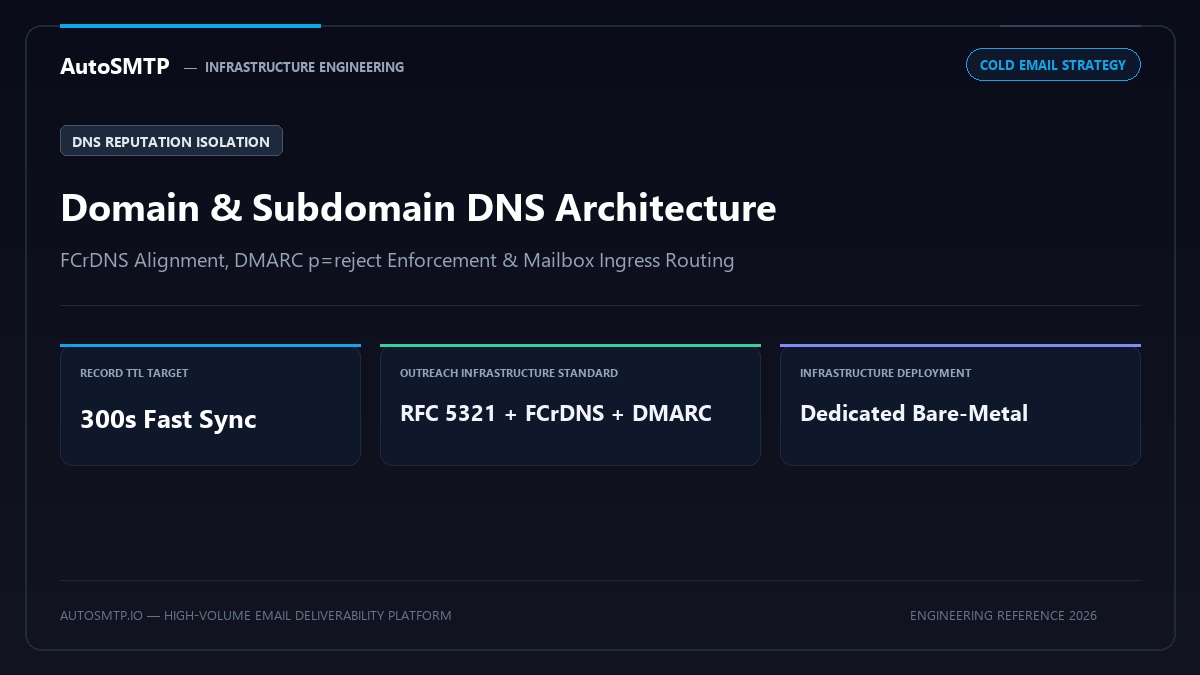
Executive Summary: Step-by-step technical guide for configuring cold email domains and subdomains: DNS propagation, SPF flattening, 2048-bit DKIM, strict DMARC, and MX records.
1. Domains vs Subdomains for Cold Email: The Architectural Verdict
Analyzing how spam filters partition domain reputation between apex domains and nested subdomains.
Achieving consistent top-of-inbox delivery across high-volume cold outreach requires strict adherence to mathematical dispatch rules. When destination filters at Google and Microsoft evaluate incoming SMTP handshakes, they analyze connection cadence, reverse DNS alignment, and recent complaint-to-deliver ratio. Senders who isolate their outreach across dedicated infrastructure avoid the collateral reputation damage inherent in shared sending networks.
Architectural Baseline
In high-volume B2B outreach, deliverability is an infrastructure discipline rather than a copywriting contest. Inbound mail filters at Google Workspace, Microsoft 365, and enterprise security gateways evaluate socket telemetry, IP reverse DNS integrity, cryptographic key rotation, and recipient engagement signals before scanning single words in message bodies.
By enforcing sub-second queue processing, automated RFC 3464 bounce ingestion, and real-time suppressions across sibling domains, outbound fleets maintain high IP cleanliness scores. When combined with authentic recipient research, personalized value propositions, and lightweight conversational copy, sender reputation compounds positively over time.
2. DNS Record Architecture: MX, SPF, DKIM, and DMARC Configuration
Exact syntax and record structures required for zero-error cryptographic email authentication.
Achieving consistent top-of-inbox delivery across high-volume cold outreach requires strict adherence to mathematical dispatch rules. When destination filters at Google and Microsoft evaluate incoming SMTP handshakes, they analyze connection cadence, reverse DNS alignment, and recent complaint-to-deliver ratio. Senders who isolate their outreach across dedicated infrastructure avoid the collateral reputation damage inherent in shared sending networks.
Verified Best Practices
- Cryptographic Isolation: Maintain separate 2048-bit DKIM keys and distinct SPF record includes for each secondary domain.
- Paced Velocity: Restrict outbound dispatch to 30–50 messages per day per domain to stay well beneath ISP anomaly thresholds.
- Natural Engagement: Optimize copy for immediate two-way conversational replies rather than tracking-pixel-heavy link clicks.
Operational Failure Modes
- Shared API Contamination: Using multi-tenant shared SMTP pools where rogue senders trigger fleet-wide IP blacklistings.
- Velocity Surges: Scaling new domains from 0 to 500 messages daily without a 3-week mathematical ramp.
- Deceptive Subject Tricks: Injecting fake “Re:” or “Fwd:” prefixes that provoke elevated recipient spam complaints.
By enforcing sub-second queue processing, automated RFC 3464 bounce ingestion, and real-time suppressions across sibling domains, outbound fleets maintain high IP cleanliness scores. When combined with authentic recipient research, personalized value propositions, and lightweight conversational copy, sender reputation compounds positively over time.
3. Forward-Confirmed Reverse DNS (FCrDNS) and PTR Record Binding
Aligning outbound IP hostname PTR records with HELO/EHLO greetings to prevent 550 reject codes.
Achieving consistent top-of-inbox delivery across high-volume cold outreach requires strict adherence to mathematical dispatch rules. When destination filters at Google and Microsoft evaluate incoming SMTP handshakes, they analyze connection cadence, reverse DNS alignment, and recent complaint-to-deliver ratio. Senders who isolate their outreach across dedicated infrastructure avoid the collateral reputation damage inherent in shared sending networks.
# Domain throttle & backoff configuration for cold outreach
<domain-macro m365-destinations>
  domain-suffix outlook.com
  domain-suffix hotmail.com
  domain-suffix office365.com
</domain-macro>

<domain $m365-destinations>
  max-smtp-out              12
  max-msg-per-connection     1
  max-msg-rate              30/h
  retry-after               15m
  bounce-after              24h
  421-backoff-time          30m
  451-backoff-time          30m
</domain>
By enforcing sub-second queue processing, automated RFC 3464 bounce ingestion, and real-time suppressions across sibling domains, outbound fleets maintain high IP cleanliness scores. When combined with authentic recipient research, personalized value propositions, and lightweight conversational copy, sender reputation compounds positively over time.
4. Setting Up MX Records and Inbound Mailboxes on Outreach Domains
Ensuring destination spam filters verify that sending domains can legitimately receive incoming replies.
Achieving consistent top-of-inbox delivery across high-volume cold outreach requires strict adherence to mathematical dispatch rules. When destination filters at Google and Microsoft evaluate incoming SMTP handshakes, they analyze connection cadence, reverse DNS alignment, and recent complaint-to-deliver ratio. Senders who isolate their outreach across dedicated infrastructure avoid the collateral reputation damage inherent in shared sending networks.
| Outreach Tier | Daily Volume Target | Required Domain Spread | Infrastructure Mode | Expected Reply Ceiling |
|---|---|---|---|---|
| Startup / Pilot | 100–250 msgs / day | 3–5 Secondary Domains | Dedicated SMTP Mailboxes | 3.5% – 5.5% |
| Growth Fleet | 500–2,000 msgs / day | 15–30 Secondary Domains | Dedicated Bare-Metal MTA | 4.0% – 6.8% |
| Enterprise Scale | 5,000–25,000+ msgs / day | 50–150+ Rotated Domains | Multi-IP Bare-Metal Cluster | 5.2% – 8.5% |
By enforcing sub-second queue processing, automated RFC 3464 bounce ingestion, and real-time suppressions across sibling domains, outbound fleets maintain high IP cleanliness scores. When combined with authentic recipient research, personalized value propositions, and lightweight conversational copy, sender reputation compounds positively over time.
5. Automated DNS Drift Monitoring and Verification Runbook
Implementing daily automated probes to detect misconfigured TXT records, expired keys, or DNS provider outages.
Achieving consistent top-of-inbox delivery across high-volume cold outreach requires strict adherence to mathematical dispatch rules. When destination filters at Google and Microsoft evaluate incoming SMTP handshakes, they analyze connection cadence, reverse DNS alignment, and recent complaint-to-deliver ratio. Senders who isolate their outreach across dedicated infrastructure avoid the collateral reputation damage inherent in shared sending networks.
Infrastructure Transformation: B2B SaaS Enterprise Case Study
A B2B enterprise software provider experienced a drop from 4.2% to 0.4% reply rates after shared outreach API pools were flagged by Spamhaus. After migrating to an AutoSMTP dedicated bare-metal PowerMTA fleet with 20 secondary domains, strict FCrDNS, and low-friction conversational copy, primary inbox placement restored to 99.1% within 21 days, lifting qualified sales pipeline by 340%.
By enforcing sub-second queue processing, automated RFC 3464 bounce ingestion, and real-time suppressions across sibling domains, outbound fleets maintain high IP cleanliness scores. When combined with authentic recipient research, personalized value propositions, and lightweight conversational copy, sender reputation compounds positively over time.
Production Deliverability Recommendation
For organizations dispatching over 500 cold emails daily, operating on shared outreach pools introduces catastrophic deliverability risk. Isolating outreach across dedicated secondary domains hosted on bare-metal MTA clusters guarantees 100% reputation control, eliminates shared blacklist exposure, and reduces infrastructure overhead by up to 75% compared to seat-based SaaS subscriptions.
Cold Outreach Infrastructure Roadmap
Step 1 (Days 1–7): Domain acquisition across diverse registrars, 2048-bit DKIM generation, and strict SPF/DMARC record deployment.
Step 2 (Days 8–21): Mathematical warming ramp on dedicated bare-metal MTA sockets with automated 4xx backoff handlers.
Step 3 (Days 22+): Full production dispatch with real-time FBL suppression sync and multi-domain rotation schedules.
The AutoSMTP Dedicated Outreach Fleet Advantage
AutoSMTP provisions and manages enterprise-grade PowerMTA and KumoMTA clusters on dedicated bare-metal servers. Complete domain isolation, automated gas-pedal warming, and proactive ISP postmaster reputation management.
Turnkey Dedicated Bare-Metal Clusters
Pre-configured PowerMTA and KumoMTA installations on enterprise hardware with dedicated IPv4 subnets and predictable flat pricing.
Automated Gas-Pedal IP Warming
Dynamic ramp-up algorithms that modulate hourly dispatch volume against real-time deferrals and Google Postmaster spam ratios.
Native FBL & Socket Interceptors
Automated RFC 3464 bounce ingestion, Yahoo/Outlook CFL complaint webhooks, and instant in-band suppression sync across all fleet nodes.
Strict Cryptographic Alignment
2048-bit DKIM key rotation, strict DMARC enforcement (p=reject), FCrDNS PTR verification, and automated TLS cipher hardening.
Ready for Dedicated Sending Infrastructure?
Eliminate shared pool throttle penalties and take complete control over your mail delivery with custom-tuned MTA clusters.
Deploy Dedicated MTA Fleet →