

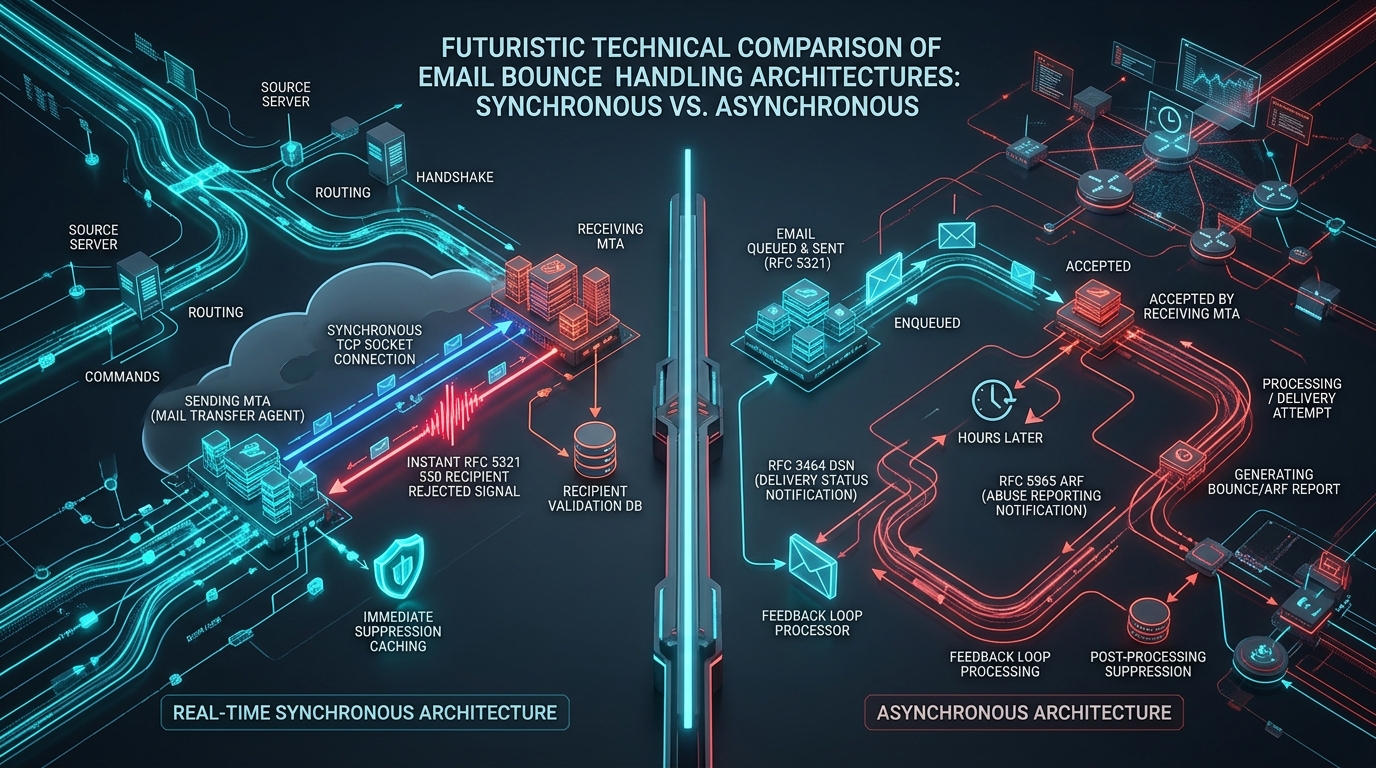
The Critical Distinction in Bounce Architecture
When an MTA attempts to deliver an email to a destination mail exchanger (such as gmail-smtp-in.l.google.com), rejections occur at two completely different stages of the delivery lifecycle:
- In-Band (Synchronous) Bounces: The destination server evaluates the connection during the active SMTP conversation (
HELO,MAIL FROM,RCPT TO, orDATA). If the mailbox does not exist (550 5.1.1) or the IP is blocked (554 5.7.1), the receiving server terminates the transaction immediately before accepting the message. - Out-of-Band (Asynchronous) Bounces: The destination server initially accepts the message with a
250 2.0.0 OK, but internal content filters, secondary mail routing, or recipient mailbox delivery fails later. The receiving server generates an automated Delivery Status Notification (DSN RFC 3464) and emails it back to yourReturn-Pathaddress. - Complaint Feedback Loops (FBL): The recipient clicks “Report Spam” inside Yahoo, Outlook, or AOL. The ISP packages the complaint as an Abuse Reporting Format (ARF RFC 5965) message and delivers it to a designated mailbox.
Protocol Comparison Matrix
| Attribute | Synchronous In-Band Rejection | Asynchronous DSN / FBL Report |
|---|---|---|
| Protocol Layer | RFC 5321 SMTP Conversation (TCP Socket) | RFC 3464 DSN & RFC 5965 ARF (Secondary Inbound Email) |
| Timing | Instantaneous (0 – 50 milliseconds) | Delayed (minutes to 24+ hours) |
| Common Causes | Unknown recipient (550 5.1.1), IP blocked (554), TLS rejected | Spam complaint, quota full, internal mailbox corruption |
| Network Overhead | Zero byte transmission beyond headers/RCPT | Full message transferred, plus secondary bounce message |
| Suppression Urgency | Critical: Retrying triggers immediate IP rate limits | High: Must suppress contact before next campaign run |
| Detection Mechanism | MTA Delivery Worker socket log parser | POP3/IMAP mailbox polling or webhook ingestion |
How Socket Rejections Occur in the SMTP Dialog
Notice below how a synchronous in-band bounce occurs directly on the wire without ever transmitting the email payload:
<< 220 mx1.destination.com ESMTP Postfix
>> EHLO mail.autosmtp.net
<< 250-mx1.destination.com
<< 250 STARTTLS
>> STARTTLS
<< 220 2.0.0 Ready to start TLS
… [TLS 1.3 Handshake Negotiated] …
>> MAIL FROM:<bounces@outbound.autosmtp.net>
<< 250 2.1.0 Ok
>> RCPT TO:<invalid-user-12345@destination.com>
<< 550 5.1.1 <invalid-user-12345@destination.com>: Recipient address rejected: User unknown in virtual mailbox table
>> QUIT
<< 221 2.0.0 Bye
AutoSMTP Real-Time Dual-Layer Bounce Engine
Layer 1: Synchronous Socket Interceptor
AutoSMTP’s underlying MTA daemon captures 550, 551, and 554 responses the millisecond the socket drops. The email address is added to the global suppression cache instantly, stopping all queued batches across the entire cluster from attempting another connection.
Layer 2: Automated FBL / ARF Parser
For asynchronous bounces and Yahoo/Outlook ARF complaints, AutoSMTP’s background worker (fbl_worker.php) continuously consumes feedback loop mailboxes, normalizes the complaint headers, records recipient metrics, and notifies your CRM or marketing automation tool via webhooks.
Protect Your Sending Reputation
Deploy AutoSMTP with zero-lag synchronous bounce suppression and automated multi-ISP feedback loops.
Explore AutoSMTP Dedicated Plans →